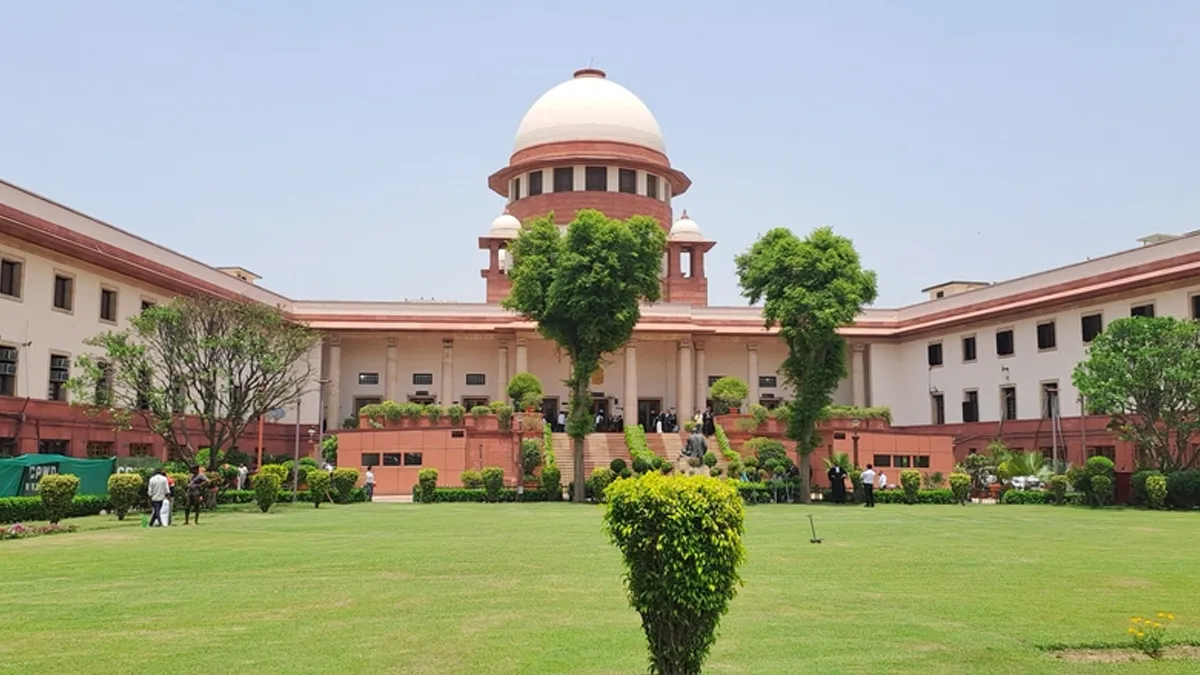
Even God Waited To Hear Adam: Supreme Court And The Crisis of Process
In the annals of common law, few cases are as evocative as Dr. Bentley’s Case (1723). When the University of Cambridge stripped Dr. Bentley of his degrees without a hearing, the King’s Bench famously restored them. Justice Fortescue, in a flourish that has echoed through three centuries of jurisprudence, invoked a precedent higher than any constitution.
"Even God himself did not pass sentence upon Adam before he was called upon to make his defence. 'Adam' (says God), 'where art thou? Hast thou not eaten of the tree whereof I commanded thee that thou shouldst not eat?'"
The force of this invocation lay not in theology, but in constitutional instinct. Authority, Justice Fortescue implied, derives its legitimacy not from omniscience, but from restraint. Power becomes lawful only when it pauses to listen. If even the omniscient Creator, who requires no evidence to discern the truth, paused to accord the accused a hearing before passing a judgment, then a human court, bound by fallibility and law, can claim no lesser obligation.
Whatever one's views on animal management, public safety, or competing claims upon urban space, Justice Fortescue's insight in Dr. Bentley's Case remains instructive. Judgment derives its legitimacy not from the authority that pronounces it, but from the fairness of the process that precedes it. Recent proceedings in Suo Moto Writ Petition (Civil) No. 5 of 2025, popularly referred to as the street or community animals matter, has raised deeply troubling questions: whether process still matters when outcomes seem urgent; whether hearing becomes optional when minds appear already made; and whether the Hon’ble Supreme Court, in this instance, has exempted itself from procedural disciplines it otherwise treats as fundamental to justice.
1
2
3
4
From Cognizance to Adjudication Without Trial
The proceeding was triggered by newspaper reporting. That, in itself, is not unexceptionable; courts have long taken suo motu cognizance based on media reports. But cognizance is not adjudication. It is settled law that newspaper reports may spark inquiry, but cannot constitute evidence. They are hearsay. They are not tested by cross-examination. They reflect editorial choice, not verified fact.
Yet the present orders contemplate sweeping, pan-India action; relocation exercises, land identification, mobilisation of workforces, and financial commitments running into thousands of crores. These directions appear to have been cumulatively informed by a series of newspaper reports relied upon by the Hon’ble Court, without any intervening independent fact-finding exercise, expert commission, or data verification mechanism proportionate to the scale and irreversibility of the measures ordered. If this approach becomes precedent, what prevents governance by headline?
Interim Orders Functioning as Final Judgments
The orders in question are passed at what is formally described as an interim stage. But they mandate infrastructure that will take years to build and thousands of crores to fund. Once land is acquired, animals relocated, and machinery set in motion, what exactly remains to be "finally" decided? Interim relief exists to preserve rights pending adjudication, not to exhaust them. The distinction between interim and final relief is not merely semantic; it is foundational to adjudicatory fairness, reflected in the Hon’ble Court’s consistent refusal to permit interim orders that grant relief final or irreversible in substance. When the "interim" creates an irreversible fait accompli on the ground, the right to a final hearing becomes a hollow formality. The horse of adjudication has been overtaken by the cart of implementation.
The Right to Be Heard: A Constitutional Guarantee
The principle of audi alteram partem, the right to be heard, is not a decorative formality; it is the soul of natural justice. It cannot be sidelined in the name of administrative convenience or speed. In the proceedings of this case, a phalanx of Senior Counsel, representatives of multiple States, and various intervenors stood ready to assist the Court. Thousands of pages of scientific data, municipal constraints, and legal arguments had been meticulously filed, waiting to be ventilated.
Yet, orders of decisive national consequence were passed while these parties remained unheard. To proceed to a judgment of such magnitude while reducing the advocates of the affected parties to mere spectators is more than a procedural lapse; it is a constitutional injury. Even under the "Parens Patriae" jurisdiction, procedural flexibility cannot degenerate into arbitrariness. To deny hearing to parties who will bear the direct burden of implementation is not flexibility. It is a complete abdication of process.
Institutional Capacity and the Separation of Powers
Beyond procedure lies the question of institutional realism. The doctrine of the separation of powers is not merely a formalistic division of labour; it is rooted in institutional humility. When a Court mandates nationwide infrastructure and massive public expenditure, absent budgetary analysis, federal consultation, or a statutory framework, it edges dangerously close to judicial substitution for legislative and executive functions. Courts possess neither the "purse nor the sword." By bypassing the executive's role in policy formulation and the legislature’s role in fiscal allocation, such directions risk creating mandates that are as administratively unworkable as they are constitutionally overreaching. Legitimacy is maintained when the Court acts as a check on power, not when it attempts to wield the power of administration itself.
Financial Preconditions and Access to Justice
An unprecedented feature of this case is the imposition of monetary deposits as a precondition for certain parties to participate. The exact legal basis for this requirement is unclear. It is not a filing fee. It is not a cost order imposed after adjudication. It is not security for costs. It appears to be a filter, a financial threshold for being heard.
In a proceeding initiated suo motu, where the Court itself assumes jurisdiction in the asserted public interest, the introduction of financial preconditions for participation raises a deeper concern. If the Court calls a matter to itself, on what basis can access to the resulting proceedings be conditioned upon the ability to pay? The integrity of open justice depends upon the assurance that the right to be heard is not rationed by financial capacity, a concern that speaks directly to the guarantee of equality before the law.
Don't miss: Is Majnu Ka Tila Getting Closed? Why Delhi High Court Is Taking Action Against 'Illegal’ Structures
Letters Heard, Letters Ignored
It is a matter of record that more than 2.5 lakhs of citizens have addressed letters to the Court on this issue. The Supreme Court’s own history recognises epistolary jurisdiction as a vital instrument of access to justice. There is a stark institutional irony when a single newspaper report triggers suo motu action, while mass citizen communications remain selectively unheard and invisiblised. This inconsistency risks creating a perception that the Court’s ear is tuned more sharply to the headlines of the few than the collective pleas of the many.

Don't miss: What Are Personality Rights? Shilpa Shetty Approaches Bombay HC To Safeguard Her Image
Why This Matters Beyond the Case
The legitimacy of the judiciary does not flow from power, but from the public’s faith in the integrity of the process. That faith is sustained by the singular assurance that the Supreme Court listens before it decides.
This moment calls for a moment of institutional pause—a recall, a reconsideration, or at the very least, a commitment to a full, patient, and meaningful hearing. To return to Justice Fortescue’s wisdom: if the Divine paused to hear Adam before casting him out, the highest court of the land can surely pause to hear its citizens before casting its order. The gravest risk here is not an incorrect outcome, but the normalisation of a jurisprudence in which process is treated as a dispensable inconvenience.
Gauri Maulekhi,
Head, People For Animals (PFA), India.
For more such stories, stay tuned to HerZindagi.
Image credit: Freepik
Also watch this video
Herzindagi video
1
2
3
4