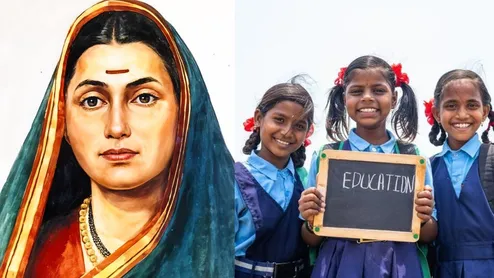
Going to school, thinking about higher education, planning a career: these things are a common phase of an individual's life. But there was a time when these things were considered a crime for women; the courage of people like Savitribai Phule changed that. In the 1800s, formal education for Indian girls was non-existent, as women were considered better suited only for domestic chores and becoming an ideal wife.
What Was Education Like For Indian Girls Before Savitribai Phule Took A Stand?
Before 1848, when Savitribai Phule, along with her husband, established the first school for girls, life was different for women, as education was made a priority for them.
Who was Savitribai Phule?
Savitribai Phule was an educator, poet, and social reformer who is known as the first Indian female teacher. She relentlessly worked to advance women's rights and education in Maharashtra and is even considered a frontrunner of India's feminist movement.
She also worked to abolish discrimination and the unfair treatment of people based on caste and gender.
What was the condition of women's education before 1848?
Things were not even nearly the same as the today’s world we live in. Due to the norms of patriarchal society, the social and legal status of women was completely different.
Education was considered a taboo for women, as they were prepared to be an ideal wife and mother. Female literacy was nearly zero, and women were strictly confined to domestic chores and household management.
Apart from denying education, there were several ill practises prominent in that era, like Sati and child marriages. Even though the Bengal Sati Regulation Act in 1829 was established by the British colonial government to legally abolish Sati, the custom remained prevalent in many regions.
Widows and even young child widows were strictly forbidden from marrying again. In many regions, they were also forced into a life of severe asceticism, which included having their heads shaved, wearing only coarse white clothing and being cast out of society. Child marriage was prevalent, and girls were sometimes married off even before they reached puberty.
How did Savitribai Phule contribute to women's education?
Savitribai Phule, along with her husband Jyotirao Phule, worked relentlessly to bring education to women in India at a time when it was considered a taboo. By 1851, they had established three girls' schools in Pune, with around 150 students and later opened a total of 18 schools.
She taught a progressive syllabus of mathematics, science, and social studies despite strong opposition from society.
Conclusion:
The courage of Savitribai Phule, who was also once illiterate, was the beginning of the education reforms for women in India. Every girl who goes to school today carries forward her dream.
(Image Credits: Pinterest)
To read more such stories, stay tuned to Her Zindagi.