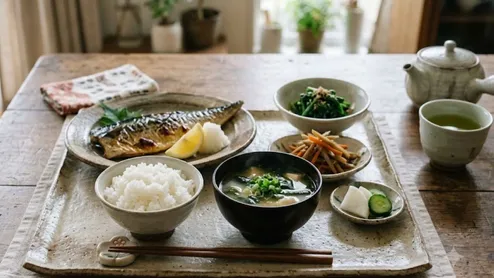
Japanese culture has inspired the world with several lifestyle practices over the centuries that promote longevity, balance, good health, and a fulfilling life. The latest term, called 'Ichiju-Sansai', a 500-year-old Japanese method that literally translates to 'one soup, three dishes', has sparked the conversation around a balanced diet again. This method aims to simplify healthy eating, while also focusing on nourishing food on your plate. Before exploring how to incorporate this centuries-old method into an Indian meal, here's everything you need to know about 'Ichiju-Sansai'.
What is Ichiju-Sansai?
Ichiju-Sansai means 'one soup and three dishes', usually consisting of a bowl of steamed rice, a bowl of warm soup, two vegetable- or seaweed-based side dishes and one protein-rich main dish. A small pickled vegetable is also added to complete the whole meal.
Its origin goes back to the Heian period court cuisine, 794 to 1185, and later evolved through the Muromachi period, from 1336 to 1573. This method of eating was later standardised by the Edo Period, 1600 to 1868.
In the modern context, this method aims to reflect nutritional needs for a meal while adding aesthetic presentation.
ALSO READ- Want A Healthier Gut This Monsoon? Add These 5 Superfoods To Your Diet
Is It Possible To Adapt Ichiju-Sansai To An Indian Vegetarian Diet?
According to Dr Komalpreet Kaur Bhangu, Homoeopath and Dietician, yes, it is entirely possible to follow the Ichiju-Sansai with the Indian vegetarian diet. " It is useful for balancing a meal because it provides protein, fibre, vitamins, and minerals. A protein-rich soup can be served with rice or other grains," she states.
Vegetarian food items like rajma, chole, moong dal, along with curd, rotis, and green vegetables can be used to create your meal, incorporating this 500-year-old Japanese method in the Indian diet.
She further adds, “It can easily be adapted to Indian tastes and flavours, making it beneficial for both sedentary lifestyle individuals and working people.”
Meanwhile, Dt. Anushi Jain emphasises that we should "embrace the philosophy behind Ichiju-Sansai and apply it using our own traditional Indian meals" rather than completely copying the method. “You don’t need to eat like the Japanese. You need to eat with the wisdom they preserved- balance, variety, seasonality, and simplicity. Our Indian thali already has that power,” she adds.
What Are Things You Need To Keep In Mind While Following This Method With Indian Food?
Dt. Supriya Saurabh Thorat, Vencer Hospital, Pune, highlights that the health benefits will come home cooking methods like "steaming, sautéing, grilling over deep frying" are used. “ Use coconut or olive oil (heart-healthy monounsaturated fats and antioxidants, reducing cardiovascular risk and inflammation). Coconut oil is rich in Medium-Chain Triglycerides (MCTs), which the body converts quickly into energy, salt and cream,” she says.
At its core, Ichiju-Sansai is about having a balanced meal without following a strict diet. Indian can use this method too while keeping a few things in mind.
If you liked this story, please share it. To read more such stories, stay connected to HerZindagi.
(Image Credits: Magnific)