
Wooden vs Plastic Chopping Boards: Which One Is Safer For Your Kitchen?
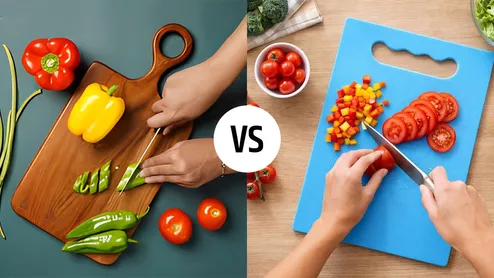
The chopping board plays an essential role in the daily practice of preparing meals in the kitchen; yet, its hygiene has always been discussed in the world of cooking. Typically, this debate focuses on which chopping board, either a wooden or nonporous plastic one, is better in terms of healthiness for food preparation. Even though plastic chopping boards used to be perceived as cleaner due to their ability to wash in the dishwasher, recent research proves that the case is much different now. Here’s where comparison of both types about hygiene, durability, microplastics, and knife care will help.
Wooden vs Plastic Chopping Boards: Key Safety Comparisons
Feature |
Wooden Chopping Board |
Plastic Chopping Board |
Bacterial Resistance |
Absorbs and neutralises bacteria in inner fibers |
Holds germs on surface; grooves trap bacteria |
Microplastic Risk |
Zero (100% Natural) |
High (Sheds micro-particles during cutting) |
Dishwasher Safe |
No (Hand-wash and dry only) |
Yes (Tolerates high-heat sanitation cycles) |
Knife Friendliness |
Very gentle on steel blades |
Moderate (Dulls blades faster than wood) |
Lifespan |
Long (Can be sanded down and re-oiled) |
Short to Medium (Must be replaced when deeply scarred) |
1. Bacterial Hygiene and Antibacterial Action
Wood: Maples, walnuts, teaks, and acacias have capillary systems in nature along with antibacterial qualities. Once bacteria get onto a wooden surface from food sources, they are drawn into the wood pores as the water evaporates, leaving the bacteria trapped without any oxygen and killing them within minutes.
Plastic: The nonporous surfaces of plastic cutting boards leave the liquid and bacteria on their surface, while brand new plastic cutting boards are easily sanitised. However, knife slashes form microscopic scars, which become homes for bacteria to reside in their biofilms and be resistant to hand washing.

2. Microplastic Contamination
Wood: The wood cutting boards are 100% organic material and contain no synthetic polymers, thus posing no threat of contamination with chemicals or plastic particles in your food.
Plastic: Studies conducted by scientists recently have revealed that the cutting of veggies and meat on plastic boards results in the shedding of microscopic pieces of plastic. With constant use for a whole year, millions of pieces of microplastics enter the prepared food.
ALSO READ- Difference Between Shoes vs Sneakers: What Defines The Beauty And How To Style
3. Cleaning, Dishwasher Safety and Maintenance
Wood: Wooden chopping boards cannot be washed inside a dishwasher since extreme heat and water lead to warping, cracking, and splitting. Hand washing with warm and soapy water, followed by thorough drying and conditioning with mineral oil is what is required to prevent the wood from drying.
Plastic: Plastic chopping boards are the most convenient type of chopping boards. They are light in weight, water-resistant, and dishwasher-friendly. Extreme heat inside dishwashers sterilises plastic chopping boards, dissolving the remaining fat on them.

4. Impact on Knife Blades
Wooden: Hardwood is a forgiving surface for cutting; this surface will absorb impact from the sharp edges of the knives, hence keeping the blades sharp and avoiding chipping.
Plastic: Plastic cutting boards are softer compared to glass and stone cutting boards; hence, they produce higher friction on steel blades of the knives.
ALSO READ- Mfg Date V/s Expiry Date: What Is The Difference And How It Can Affect Your Health?
Conclusion
The safest method would be using a combination of boards: a dishwasher-friendly plastic board to cut your meat and fish so that you can wash the board using heat sterilisation, while a wooden board to cut fresh fruits and vegetables because of its inherent antibacterial properties and does not contain microplastics.
Image credits: Freepik
For more such stories, follow HerZindagi!
- Q1: How do I sanitise a wooden chopping board without ruining it?
- To sanitise, wipe the surface with diluted white vinegar or a hydrogen peroxide solution, rinse thoroughly, and stand it upright to dry completely.
- Q2: When should I discard and replace a plastic chopping board?
- Plastic boards should be replaced as soon as they develop deep, rough knife grooves or frayed plastic threads.
- Q3: Is bamboo safer than traditional hardwood chopping boards?
- Yes, bamboo is highly hygienic.
Our aim is to provide accurate, safe and expert verified information through our articles and social media handles. The remedies, advice and tips mentioned here are for general information only. Please consult your expert before trying any kind of health, beauty, life hacks or astrology related tips. For any feedback or complaint, contact us at compliant_gro@jagrannewmedia.com.