
Why Is Navratri Celebrated For Nine Nights? Know The Meaning Behind Each Day
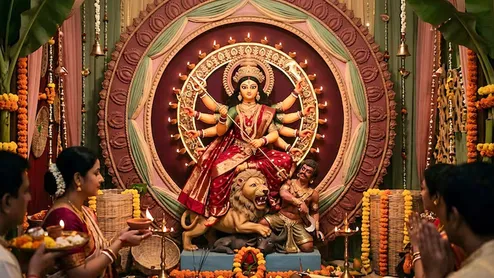
Among the Hindu festivals celebrated by many, the Navratri festival is one of the most esteemed celebrations of the goddess Durga’s divine energy (Shakti). The Navratri festival celebrates the victory of the goddess over evil on earth. The name ‘Navratri’ is derived from the Sanskrit language, meaning ‘nine nights’. Each night is marked by offering prayers to different forms of the goddess referred to as Navadurga.
Why Is Navratri Celebrated For Nine Nights?
Nine days are symbolised by the time when Goddess Durga had to engage in a brutal fight with the evil demon king Mahishasura. As per Hindu mythology, Mahishasura had received invincible power through a boon, making himself incapable of being killed by anyone, either human or divine. It was only after combining their powers that the Holy Trinity consisting of Brahma, Vishnu, and Shiva created Goddess Durga, who killed the demon king by fighting with him for nine days continuously.
What Is The Significance Of Nine Nights And Ten Days?
The number nine represents wholeness and perfection in Vedic philosophy. Each of the nine nights represents the nine steps of spiritual enlightenment that aid believers in purifying themselves mentally, physically, and spiritually:
First Three Nights (Nights 1-3): Devoted to cleansing oneself from bad attributes.
Middle Three Nights (Nights 4-6): Aimed at acquiring spiritual wealth.
Last Three Nights (Nights 7-9): Aimed at reaching higher states of consciousness.
Navadurga: The Nine Manifestations Of Maa Durga
Day 1 — Maa Shailputri
Meaning and Significance: She is the incarnation of Goddess Sati as the daughter of King Himavat and is known as the ‘Daughter of the Mountains.’ She mounts a bull and holds a trident and lotus.
Reasons Why Her Devotees Revere Her: She stands for the root energy (Muladhara Chakra), giving strength, stability, and solid base spiritually for the forthcoming festival season.
Day 2 — Maa Brahmacharini
Importance: She signifies profound penance, austerity, and unwavering determination.
Spiritual Significance: By worshipping her, one gains patience, discipline, and mental strength to face the challenges of life.
Day 3 — Maa Chandraghanta
Symbolism: She wears a crescent moon in the form of a bell (Chandra Ghanta) on her forehead.
Importance: Her terrifying form instils confidence in her followers and dispels all their fears.

Day 4 — Maa Kushmanda
Meaning: Her name represents the creator of the cosmos (Ku-Ooshma-Anda), created through her smile.
Religious Meaning: She symbolises good health, vitality, warmth, and wealth, illuminating the universe with her energy.
Day 5 — Maa Skandamata
Importance: She is revered as the mother of Lord Skanda (Kartikeya), the chief commander of the army of gods.
Relationship with Lord Kartikeya: Her worship automatically leads to the blessings of Lord Kartikeya, which confer pure motherly love and wisdom on us.
Day 6 — Maa Katyayani
Meaning and Importance: Daughter of Sage Katyayana, she is the war form of the goddess who led the charge against the army of Mahishasura.
Beliefs Associated: She is associated with furious rage against injustice and brings success and peace in one’s personal life.
Day 7 — Maa Kalaratri
Symbols: With a dark skin colour, unkempt hair, and fierce demeanour, she becomes the most terrifying form of the Divine Mother.
Protection from Evil Energies: Although she has a frightening image, she is referred to as Shubhankari (benevolent) as she wards off evil forces from her followers.
Day 8 — Maa Mahagauri
Definition: She stands for absolute purity, peace, and serenity and is characterised by a radiant white skin tone.
Importance of Ashtami: Worshipping her on Maha Ashtami will cleanse us of our sins and fulfil our wishes.

Day 9 — Maa Siddhidatri
Significance and Meaning: She is the source of all spiritual powers (Siddhis).
Significance of Navami: In Maha Navami, she fulfils the spiritual journey of attaining wisdom and knowledge for success in every venture.
Navadurga Significance At A Glance
Day |
Goddess |
Key Significance |
Day 1 |
Maa Shailputri |
Strength and stability |
Day 2 |
Maa Brahmacharini |
Devotion and penance |
Day 3 |
Maa Chandraghanta |
Courage and protection |
Day 4 |
Maa Kushmanda |
Creation and vitality |
Day 5 |
Maa Skandamata |
Motherhood and compassion |
Day 6 |
Maa Katyayani |
Strength and protection |
Day 7 |
Maa Kalaratri |
Protection from negativity |
Day 8 |
Maa Mahagauri |
Purity and peace |
Day 9 |
Maa Siddhidatri |
Spiritual fulfilment and blessings |
Why Does Vijayadashami Follow Navratri?
The celebration of the victory of Dharma over Adharma is called Vijayadashami. This sacred festival inspires the devotees to conquer their evil spirits such as pride, wrath, and greed and start a new life.
ALSO READ- Why Is Mumbai’s Ganesh Visarjan So Grand? The History Behind The Massive Processions
Conclusion
Navratri not only means a festival, but it also includes the process of introspection, self-control, and self-purification.
Image credits: Freepik
Stay tuned for more such stories at Her Zindagi.
- Q1: What does the word 'Navratri' mean?
- The word Navratri comes from Sanskrit, where Nava means nine and Ratri means nights, translating directly to ‘nine nights.’
- Q2: What is the main difference between Durga Puja and Navratri?
- While both celebrate Goddess Durga's victory over Mahishasura, Navratri is widely observed across Western and Northern India with fasting and Garba/Dandiya, whereas Durga Puja is a major cultural and social festival in Eastern India centred on grand pandals.
- Q3: Why do people fast during the nine nights of Navratri?
- Fasting during Navratri serves to detoxify the body, cultivate mental discipline, and align individual energy with divine spiritual vibrations.
Our aim is to provide accurate, safe and expert verified information through our articles and social media handles. The remedies, advice and tips mentioned here are for general information only. Please consult your expert before trying any kind of health, beauty, life hacks or astrology related tips. For any feedback or complaint, contact us at compliant_gro@jagrannewmedia.com.