Holi: The Significance of Tagore’s Basanta Utsav
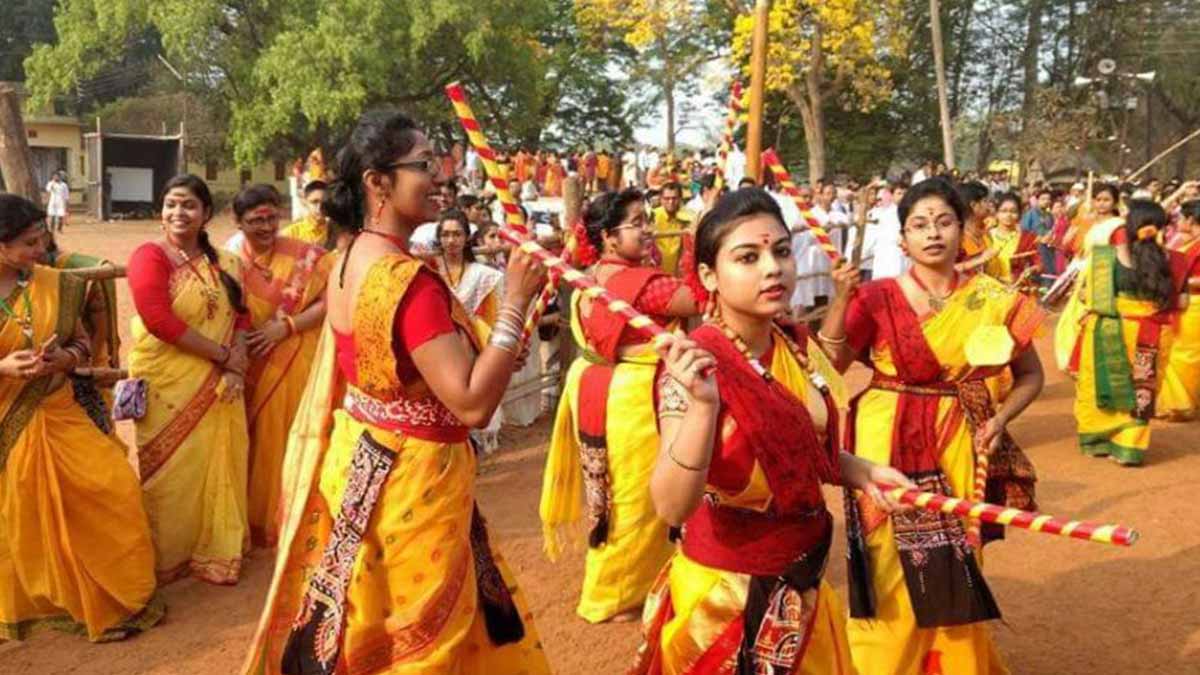
As Holi, one of the biggest North-Indian festivals, is knocking at the door, West Bengal is prepping for one of their most awaited festivals of the year, Basanta Utsav. Founded by Nobel laureate poet Rabindranath Tagore at Visva-Bharati University in Santiniketan, West Bengal, the festival is about honouring and celebrating spring and its hues. Commonly known as Dol Utsav, it is usually held a day ahead of Holi on the day of Dol Purnima (the full moon day of Falgun).
However, this year, Basanta Utsav is scheduled to be celebrated on March 8, on the day of Holi.

Origin of Basanta Utsav
Basanta Utsav, invented by Tagore in the early 1920s, celebrates the colours of phagun (spring) with flowers and abir (dry colours). The festival begins early in the morning with a parade in which teachers and students wearing basanti (yellow) sarees and kurtas sing and dance their way to Rabindra Sangeet from the university to the maidan (ground), where the stage is set. Many celebrities, former students, ashramiks (Visva-Bharati alumni who have lived in Tagore's Ashram on campus for many years and generations), and locals are among the millions of people who attend the event from all across the state, nation, and the world.
Don't Miss: A Love Letter To Tabu: The Enduring Magic She Brings To Her Characters
Later, in the day, after the cultural programes are almost over, from students and teachers to the common public and tourists, everybody engages in a celebration where they apply dry powdered colour known as abir on each other. Several celebrities, popular singers, writers, and literary personalities also visit the festival every year and engage in singing and dancing in groups amidst the crowd.
1
2
3
4
Visva-Bharati University

In contrast to the westernised model of education, Tagore, who couldn't stay confined inside the four walls of a classroom, supported traditional and old Indian education. In Bengal's Birbhum district, he created open-air classrooms in Santiniketan. Lessons are even now taught outside in open areas where children can have direct access to nature, under trees, at the school known as Patha Bhavan. The Visva-Bharati University offers a variety of undergraduate, post-graduate, diploma, and doctoral courses with a focus on music, the arts, performing arts, languages, social work, agriculture, rural, cottage, and handicraft industries, among other things.
Don't Miss: Ishaan Khatter: From Beyond The Clouds To A Suitable Boy, He Is Here To Stay
According to Tagore, creativity has no bounds and that creativity cannot be contained within the four walls of a classroom. In order to reduce air pollution, residents and students still live in mud huts with thatched roofs as part of the university infrastructure, which did not have any concrete boundary walls until last year.
Herzindagi video
1
2
3
4