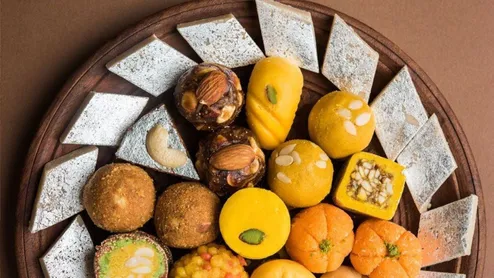
Have you ever picked up a piece of Indian sweet like Kaju Katli, Barfi, Shahi Tukda, Cham Cham or others and started by eating the silver foil before the actual mithai? Have you ever wondered why that silver foil was placed on it, what is the relevance or how it became a significant part of Indian Sweets by being placed beautifully over the centuries? Known traditionally as Chandi ka Varak/Vark, a thin paper with metallic garnish. While it gives an immediate royal, premium appearance to the delicacies, the reason to apply silver foil to mithai dates back in ancient Ayurveda, historical royal kitchens and culinary science, as Chandi vark serves a purpose that is practical and culturally accepted too.
Why Do Indian Sweets Have Silver Foil On Top?
The practice of decorating food with precious metals dates back to ancient India and Middle East traditions. During the Mughal Era, the royal chefs extensively used chandi and sona foils to garnish the food served to kings and emperors for royalness and garnishing. It was not merely a symbol of wealth, but also was belived that it refined the flavours and provided sophistication.
Over centuries, this royal court tradition trickled down into everyday Indian sweet-making, turning vark into an essential element of festive gifting and celebration.
What Is Chandi Vark And Why Is It Used On Mithai?
Chandi Vark is an ultra-thin, edible foil made from pure silver. It is used to decorate traditional Indian sweets like Kaju Katli, Peda, or Shahi Tukda.
Natural Food Preservation: Silver has natural antibacterial properties. Before modern refrigeration existed, sweet-makers applied silver foil to milk-based sweets to protect them from bacterial growth and slow down spoilage.
Moisture Locking: The metallic barrier helps lock in moisture, preventing delicate cashew and milk paste sweets from drying out quickly when exposed to air.
Ayurvedic Wellness: In traditional Ayurvedic medicine, silver (Rajat) is considered a cooling element (Sheetal). Consumed in microscopic amounts, it is believed to help balance the body’s Pitta (heat) levels and aid digestion.
Auspiciousness and Luxury: Silver is regarded as pure (Shuddh) and auspicious in Indian culture. Garnishing with vark elevates everyday sweets into a sign of prosperity, respect, and celebration during festivals like Diwali and weddings.
Fascinating History Of Silver Foil On Indian Sweets
Authentic Chandi ka varak is created using pure, food-grade silver. Small chunks of pure silver are placed between parchment paper and pounded continuously for hours using wooden mallets. This intense manual hammering thins the silver to a microscopic thickness, creating the foil.
The foil is created so delicate that it cannot be held with bare hands; that is why it comes with a backing paper.
Is It Safe to Eat Silver Foil?
Yes, consumption of silver foil is completely safe. The Food Safety and Standards Authority of India (FSSAI) permits the consumption of silver foil in food products, provided it meets the quality guidelines:
Purity Standard: The silver used must have a minimum purity level of 99.9%.
No Animal By-products: Modern FSSAI regulations strictly prohibit traditional leather-pounding methods, mandating hygiene-tested, vegetarian machine processing.
Heavy Metal Limits: The foil must be completely free from toxic heavy metal contaminants such as lead, nickel, cadmium, or aluminum.
How To Check The Purity Of Silver Vark
- Touch Test: Pure Silver Foil is extremely fragile and instantly crumbles into tiny, invisible particles when rubbed softly with fingers. Fake aluminum foil will stick together, roll into a hard ball or feel uncomfortable.
- The Flame Test: Scrape a piece of foil off the sheet and burn it with a lighter. Pure silver turns into a tiny white-gray ash ball. If it turns black, emits bad fumes, or turns into a hard dark bead, it is adulterated or made of aluminum.
- The Rubbing Test: If the silver foil easily wipes off onto your hands and leaves a dark stain on your fingers when touching the silver, it is likely low-quality or fake.