
Multani Mitti or Salicylic Acid For Pimples? Benefits, Differences, And Which To Choose
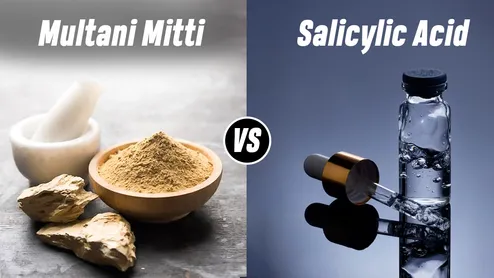
The dilemma that arises when faced with persistent pimples and oily skin could be that of choosing between an age-old homemade solution and contemporary dermatology-approved actives. Multani Mitti, commonly known as Fuller’s Earth, has traditionally been a part of many homes and has always been appreciated for its natural ability to absorb excess oils. However, Salicylic Acid, being a well-known Beta Hydroxy Acid (BHA), has been recognised for its effectiveness in deep exfoliation of pores. Although they both combat pimples, they function on different principles. Let us discuss their pros and cons.
Multani Mitti
Multani Mitti is a natural mineral-rich clay that works physically on the skin's surface.
Key Benefits:
Extraction of Sebum: Its mechanism resembles a sponge which takes sebum away from the surface of your skin.
Cooling Effect: Provides you with instant cooling effects to soothe irritated or reddened skin.
Facial Clean-up: Helps eliminate loose dirt, dead skin and impurities by washing them off.
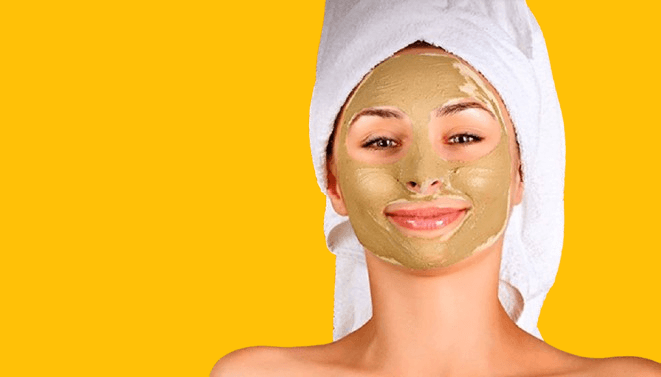
Best Suited For: Very oily skin types looking for weekly oil control, mattifying effects, or a natural face mask.
Salicylic Acid
Salicylic Acid is an oil-soluble BHA that penetrates deep inside the skin's pores rather than staying on the surface.
Key Benefits:
Deep Pore Cleansing: Breaks down sticky sebum and dead skin cells lodged inside hair follicles.
Blackheads and Whiteheads Treatment: Helps to break down non-inflammatory comedones and prevent formation of inflammatory acne.
Antibiotic and Anti-inflammatory: Helps to eliminate active inflammatory acne lesions and reduce redness and swelling.
Best Suited For: Persistent acne, blackheads, whiteheads, clogged pores, and combination-to-oily skin types.

ALSO READ- Aqualogica vs Dot & Key Sunscreen: Which One Is Actually Better For Indian Skin?
Key Differences: Multani Mitti vs Salicylic Acid
Feature |
Multani Mitti |
Salicylic Acid |
Mechanism |
Physical oil absorption on the surface |
Chemical exfoliation inside the pore |
Primary Goal |
Mattifying skin and oil control |
Treating and preventing active pimples |
Depth of Action |
Surface level |
Deep follicular penetration |
Target Breakouts |
Mild surface greasiness |
Blackheads, whiteheads, and active acne |
Frequency |
1–2 times per week |
Daily or 2–3 times weekly |
Which One Should You Choose?
Multani Mitti is the best choice for you if you have really oily skin and would like to try an affordable natural mask on a weekly basis to keep your skin matte and clean. Bear in mind that a clay mask will not be able to address deep-seated acne or bacterial cysts.
Salicylic acid is the right choice if you suffer from recurring pimples, blackheads or clogged pores.

Conclusion
These two elements are both essential for skin care; however, Salicylic Acid is definitely better when it comes to treating acne because of the way it clears clogged pores. Multani Mitti can be used once a week for the absorption of excess oil from your skin.
Image credits: Freepik
ALSO READ- Foundation vs Skin Tint: What's The Difference And Which Is Better For Daily Wear?
To read more such stories, stay tuned to Her Zindagi.
- Q1. Can I use Multani Mitti and Salicylic Acid together?
- Ans: Yes, but not at the exact same time. Using both simultaneously can over-dry and strip your skin barrier. Space them out by using Salicylic Acid in your routine and a Multani Mitti mask once a week on a different day.
- Q2. Does Multani Mitti remove blackheads permanently?
- Ans: No. Multani Mitti pulls out surface oil, which temporarily improves the look of blackheads, but it does not dissolve the deeper pore clogs as Salicylic Acid does.
- Q3. Is Salicylic Acid safe for daily use?
- Ans: Low concentrations (0.5% to 2%) in gentle cleansers or serums are safe for daily or alternate-day use, provided you follow up with a light moisturiser.
Our aim is to provide accurate, safe and expert verified information through our articles and social media handles. The remedies, advice and tips mentioned here are for general information only. Please consult your expert before trying any kind of health, beauty, life hacks or astrology related tips. For any feedback or complaint, contact us at compliant_gro@jagrannewmedia.com.