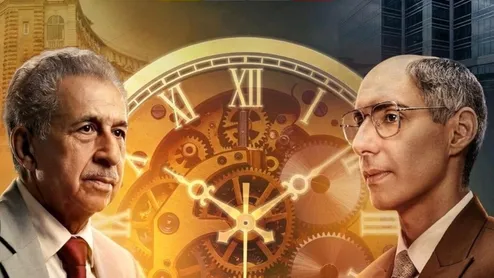
'Made in India: A Titan Story' Ending Explained: One series that people can’t get enough of this week has to be 'Made in India: A Titan Story'. Some stories are about underdogs fighting impossible odds, and ‘Made in India: A Titan Story’ is exactly that, except this underdog is an entire company. Directed by Robbie Grewal, this show is based on Vinay Kamath's book ‘Titan: Inside India's Most Successful Consumer Brand’.
The six-episode series chronicles the rise of Titan Company through the vision of Xerxes Desai and Akash Dikshit, who set out to challenge India's smuggler-dominated watch market by building a world-class Indian brand. It has received positive reviews for its performances, writing, and portrayal of India's corporate history. Let’s dive in to see the 'Made in India: A Titan Story' ending explained here to know how this Jim Sarbh and Naseeruddin Shah starrer concludes.
What Crisis Does Titan Face In The Final Episodes?
Just when it looks like Titan has made it, the show pulls the rug out completely. The final episodes place Titan in the middle of its biggest crisis, with sales beginning to fall, retailers becoming sceptical of the products, and distribution networks failing to perform as expected.
The initial excitement surrounding Titan slowly fades as financial pressure mounts from every direction. It is a classic third-act low point where the initial vision collides head-on with harsh market realities, and boardroom discussions become increasingly difficult as executives question whether the venture is still worth pursuing. The dream that united everyone at the start suddenly looks impossibly fragile.
Did JRD Tata Fulfil His Vow To Xerxes Desai?
This is the emotional heart of the finale, and it goes all the way back to a promise made years earlier. After Andre Jauba, a Swiss watchmaker, insults Indians and calls them labourers, an infuriated Mr Tata gives Xerxes the green light to pursue the watch project, pledges not to wear Andre's watch himself, and gives Xerxes five years to prove that the venture can succeed.
When the numbers stop adding up years later, that promise is put to the ultimate test. JRD's support is severely tested during board meetings where the figures simply do not justify continuing the venture, yet rather than bowing to the bankers, JRD doubles down on his backing of Xerxes, framing it not as a blind financial gamble but as a clash between a pre-liberalisation mindset that distrusts Indian manufacturing and the stubborn idealism he and Xerxes represent.
JRD's refusal to pull the plug gives Xerxes the crucial runway he needs, shifting the pressure entirely onto the company to deliver.
How Does Xerxes Desai Turn Titan's Crisis Into A Success?
This is where the show earns its title. Titan survives because Xerxes stops treating the crisis as a reputation problem and turns it into an engineering problem, with the team reuniting around the Titan Edge prototype, an ultra-slim watch that proves Indian watchmaking can compete at a world-class level.
Xerxes Desai and his core team respond by overhauling their strategy, launching the engineering marvel that is the ultra-slim Titan Edge alongside the mass-market Sonata brand to secure the company's financial future.
This ending shifts the narrative’s focus from corporate milestones to a deeply emotional vindication, proving that an Indian brand can set global standards while becoming a pillar of national pride.
What Is The Significance Of The Swiss Watchmaker Reversal?
The finale saves its most satisfying gut-punch for last, and it brings the story full circle. The larger payoff is the Swiss reversal: the company once mocked by European watchmakers eventually stands confident enough to answer that doubt through invention, and Titan later acquires the Swiss watch brand Favre-Leuba.
Titan is no longer a small dream fighting for permission to exist. It is now a national brand that can also fail publicly, and that is the real pressure the final episode carries. The same company that an arrogant Swiss watchmaker once dismissed as a nation of labourers ends up buying a piece of that very industry, and that, more than any sales figure, is the win the entire series has been building towards.
Image Credit: IMDb, X (formerly Twitter)
For more such stories, stay tuned to HerZindagi.