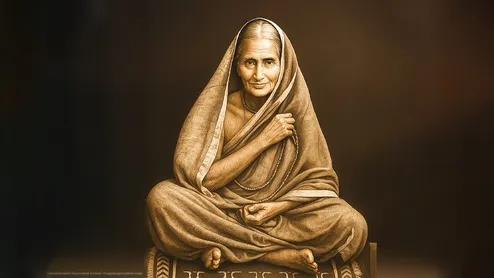
A woman reading a book in 19th-century India would be regarded as rebellion, superstition, or an indication of disorder. However, within the confines of the dark, smoky kitchen, a young married woman called Rassundari Devi learned how to read and write. With her intense spiritual desire to read religious texts, she managed to overcome the severe social taboo to narrate her own experiences. She wrote her pioneering book Amar Jiban (‘My Life’) in 1876, which marked the first full-length autobiography in the Bengali language and in India.
Who Was Rassundari Devi? India’s First Female Autobiographer
Rassundari Devi was born in about 1809 in the village of Potajia, now in Bangladesh. Her upbringing and existence were marked by the severe patriarchal customs of the time. Married to a rich, influential landowner at just twelve, she spent her childhood in a demanding routine, cooking for many family members and bearing twelve children. Nevertheless, all these difficult tasks could not overshadow her exceptional and silent intelligence, which made her the innovator of women’s Indian literature.
Why She Was Forbidden from Learning to Read
In the case of the 19th century Bengal, there was an absolute ban on formal education among females, based on a belief held by society that reading made a woman unfortunate or brought doom on her family. There was an absolute need for women to confine themselves to household chores without engaging in any intellectual activities.
How She Secretly Taught Herself to Read and Write in the Kitchen
She secretly tore off a page of her husband’s holy scripture and kept it under the kitchen stove. She had taken one of the palm-leaf pages where her child practised writing his alphabet.
In the process of cooking food, she used to draw the page out and match up the symbols written on the leaves with those in the book while keeping an eye behind her shoulder. She later learned how to write her letters on the soot-blackened walls of the kitchen after many years of learning to read.
Why Her Story Still Matters For Women Today
Rassundari Devi’s tale teaches us that the right to literacy and expression is a fundamental right of humans. Her courageous journey from a closed kitchen to becoming an author shattered centuries of suppression, which shows how the desire for something can lead one out of oppression. For today, she remains an inspiration for gender equality and women's literacy.
ALSO READ- Who Is Priti Rathi Gupta? Lxme Founder On Financial Freedom And Investing Tips For Indian Women
Conclusion
The act of hiding the torn page of a manuscript under a kitchen stove by Rassundari Devi brought about a major shift in Indian literary history. Rassundari Devi's case shows that true love of learning cannot be killed by social restrictions.
Image credits: Instagram
To read more such stories, stay tuned to Her Zindagi.