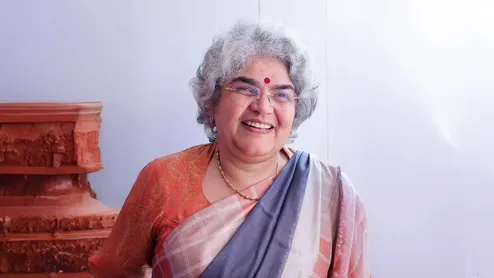
Herstory is the place where we acknowledge all those women who have accomplished many things and broken many barriers to make a positive difference in the world.
Dr Gayathri Vasudevan is a prominent development practitioner and social entrepreneur who has spent over two decades reforming India's skilling and informal labour landscape. By bridging high-level policy formulation with grassroots implementation, she has built scalable models that transform vocational training into sustainable income and dignified livelihoods.
Who Is Dr Gayathri Vasudevan?
Dr Gayathri Vasudevan possesses an academic background that ranges from economics to social work, culminating in her Doctorate in Development Studies. She is a prolific author, having published more than 30 articles on issues related to labour, employment, and gender parity. She is a recipient of numerous awards, such as the Women Transforming India award by NITI Aayog and Social Entrepreneur of the Year from Forbes India.
Dr Gayathri Vasudevan’s Journey In Skilling And Livelihoods
Development work is where Dr Vasudevan started her career after working for 8 years at the International Labour Organisation (ILO). While at the ILO, Dr Vasudevan's work revolved around labour policies, gender-transformative skilling, and the informal economy. This became her base of knowledge from which she has since provided strategic advice to organisations such as the Ministry of Labour and Employment, UIDAI, and NITI Aayog.
This is when the 'aha' moment happened for Dr Vasudevan in 2006, while interacting with a young carpenter called Raju, under a flyover. According to Raju, informal workers hardly earned good pay as there was no way of verifying their skills through any formal channel. It was this incident which gave her the fundamental idea that vocational skilling works only with formal verification, employers' trust and many other supporting factors, including family support.
What Is LabourNet And How Did She Help Build It?
Founded along with Dr Vasudevan in 2006, LabourNet is an example of a social enterprise that has been set up for the purpose of providing livelihood and improving quality of life through education, employability, and entrepreneurship.
Being aware of the fact that informal sector workers lacked any proper means to increase their incomes, she transformed LabourNet into a work-integrated skills development platform working in hundreds of centres in India. Being the CEO of LabourNet, she introduced on-the-job assessment, skill enhancement, and certification of informal workers in construction, leather, beauty, and manufacturing sectors.
ALSO READ- Who Is Rajkumari Devi (Kisan Chachi)? How She Built A Rural Food Processing Movement For Bihar Women
Dr Vasudevan’s Work With Sambhav Foundation
In the last three decades of Sambhav Foundation’s functioning, its projects have touched the lives of more than 3.2 million people. Today, its cluster-based programs cover more than 20 states and 64 sub-clusters across the country.
Trained 180,000 people, placed 85,000 into formal employment, and helped 23,400 get into self-employment.
Shifted 610 young women from Rajasthan, Odisha, and Jharkhand into formal employment and recorded a 99% retention rate (active: 604), with a return on investment of around ₹6.5 to ₹1. Organised 1,611 women waste pickers into Self Help Groups (SHGs) and generated ₹56.46 lakh worth of savings and incubated 150 nano-enterprises in 8 different sectors.
How She Is Reimagining India’s Skilling Ecosystem
Dr Vasudevan's model challenges traditional training frameworks by establishing an ecosystem where certification, employer trust, and social support structures work in unison. By partnering with global entities such as Microsoft, H&M Foundation, and Standard Chartered Bank, she demonstrates how high-level CSR and policy frameworks can translate into measurable, long-term employment outcomes. Her vision demonstrates that skill development must focus on income generation, dignity, and worker agency rather than mere completion numbers.
Why Women’s Participation In Skilling Matters
Promoting gender-transformative skilling is central to Dr Vasudevan's work. Her initiatives show that economic self-reliance directly enhances social agency and family stability:
In beauty and wellness programs, over 20,000 trained women transitioned into roles earning anywhere from ₹5,000 per month in salaried positions to over ₹1,00,000 per month running independent salons. Comprehensive support such as safe housing, social integration, and financial literacy drives high retention rates among female migrant workers. Her framework provides a tested model for the next generation of female social entrepreneurs seeking to build sustainable ventures in India.
Conclusion
Dr Gayathri Vasudevan's work bridges macro-level policy with micro-level execution. By establishing systems where skills reliably convert into sustainable livelihoods, her efforts continue to shape India's vocational training landscape for millions of workers.
Image credits: Instagram
To read more such stories, stay tuned to Her Zindagi.