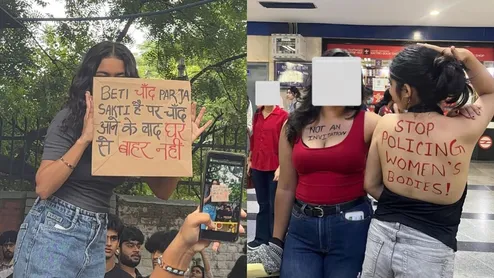
When a woman is unsafe, the first question society asks is rarely "Why did he do it?" but "What was she doing there?" From college circulars to family WhatsApp forwards, safety in India is still sold as a responsibility women must carry, not a right they are owed. In Delhi, hundreds of women are raising their voices against the poor condition of women's safety in India, countless sexual harassment cases, lack of accountability, moral policing of women, and also questioning the silence of authorities in such horrendous and tragic cases.
How Society Puts The Burden Of Safety On Women
Here's how society loves to put blame on women and make them accountable for their safety, instead of questioning those who put them in danger.
1. The Dress Code Defence
"Don't wear short clothes, cover yourself up." School handbooks, office advisories, and college notices still police hemlines in the name of safety. The unspoken message says that your clothes provoke, so you prevent. It shifts accountability from the harasser to the harassed.
2. The Curfew Culture
Hostel gates lock at around 6 to 8 PM for girls, 11 PM for boys. Parents ask you to come home before dark, putting a condition on freedom in free India. Cities tell women to avoid night travel rather than making night travel safe. When safety becomes about restricting her mobility and not expanding her freedom, the one accountable for making streets unsafe roams freely.
3. The 'Good Girl' Checklist
Women are asked not to laugh loudly, travel alone, drink, be friends with boys, and the list goes on. As the checklist grows longer, the promise of safety never arrives. Several studies show assault happens regardless of clothes, time, or sobriety, but still women are asked to follow this unsaid checklist to stay safe.
4. Victim Blaming On Repeat
From news debates to comment sections, the question stays the same: "Why was she out so late? Or what was she wearing?" This narrative makes women self-police while the system escapes scrutiny. Better street lights, safe transport, swift justice, teaching people consent, and gender sensitisation get less airtime than lessons for women.
What Real Safety Looks Like
Real safety is not when women learn to protect themselves better, but when society stops needing to teach them. It is well-lit streets, working helplines, bystander intervention, consent education, and accountability for perpetrators, not curfews for victims.
Bollywood actress Dia Mirza recently raised an important topic of not raising girls to avoid harm but to raise boys who will not cause harm.
Talking about how she chooses to raise her son, she wrote, "Every single day, I strive to teach my son the value of care, respect, empathy and kindness towards all. That means helping him understand how to respond to rejection, respect boundaries, and recognise and honour even the subtle ways in which a person may convey discomfort."
She added, "I want him to understand that consent is not merely the absence of a “no”; it is the presence of a willing and comfortable “yes.” That no one owes him their attention, affection or intimacy, and that rejection is neither an insult nor something to be challenged, negotiated or taken personally."
Recently, on Daughter's Day, Kriti Sanon also highlighted everyday fears of women and asked the public to imagine a daughter feeling followed at night or worrying when her phone dies. She noted that women are unfairly forced to build safety routines like sharing live locations and carrying pepper spray.
You cannot empower women by caging them. Till safety is about holding perpetrators accountable, teaching men and women about consent and respect and not the skirt, the burden will stay where it has always been: on the wrong shoulders.
To read more such stories, stay tuned to Her Zindagi.