Sitting down for long periods of time, typing on computers repeatedly, and keeping one’s body in an upright position for hours can result in spine compression, tight hips, tech neck, and hunched shoulders. When professional women have to deal with both stress-related jobs and high pressure in corporate environments, specific yoga asanas can help reduce any strain in their bodies. Here is a list of the five best asanas for desk jobs with detailed steps.
5 Best Yoga Asanas For Desk Job Professional Women
Here are five easy-to-do yoga asanas that professional women can perform:
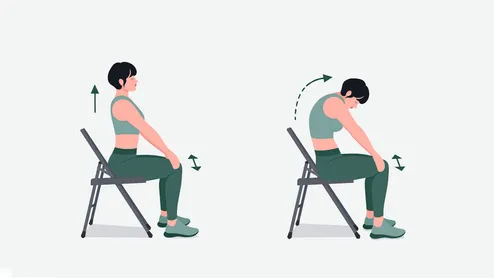
1. Seated Cat-Cow Pose (Marjaryasana-Bitilasana)
The exercise immediately increases flexibility of the spine, massages the organs in the abdominal area, and releases stiffness that has developed in the lower back, neck, and shoulder region because of prolonged hunching.
How To Perform
Sitting tall in your chair with your back straight, your knees forming a right angle, and your feet firmly on the ground, place your hands gently on your knees.
Gently arching your back, raise your chest upwards towards the ceiling, pulling your shoulders backwards and downward, and looking up.
Gently curve your upper back inwardly, bringing your chin towards your chest while pulling your stomach towards your spine.
Do this exercise for 8 to 10 breaths.
2. Chair Pigeon Pose (Eka Pada Kapotasana Variation)
Being seated all day long causes the muscles of the hip flexors to remain tight and causes an imbalance in the hips and the lower back. This particular posture works on the outer gluteal muscles.
How To Perform
Maintain an upright position near the front of the chair with your feet firmly planted on the floor.
Raise your right leg and place your right ankle above your left knee to form a figure-four pose horizontally. Bend your right foot to prevent any strain on the knee.
Make sure that your weight is evenly balanced on both buttocks.
From an upright position, bend slightly forward at the hip joint to get a mild stretch in the lateral part of the right thigh and hip.
Inhale and exhale deeply for 5 to 10 breaths, and then do the same thing with the other side.
3. Seated Spinal Twist (Bharadvajasana Variation)
Slowly twisting the torso aids in detoxification, stretches the spinal column, and also focuses on shoulder and mid-back tension due to prolonged immobility.
How To Perform
Take an upright posture on the edge of your chair with your feet flat on the floor and apart by hip distance.
Draw a deep breath to elongate the spine upwards.
Turn the body slightly to the right side and take the left arm to the right leg while the right arm grasps the backrest of the chair.
Rotate the head gently towards the right shoulder while the knees remain pointing forward.
Stay there for five breaths, return to the centre position through exhalation, and repeat the same for the left side.
4. Seated Crescent Moon Pose (Parsva Sukhasana Variation)
The side body is collapsed and compressed during prolonged computer hours, leading to pain in the ribcage, neck, and shoulders. The side body bend stretches the intercostal muscles and elongates the spine.
How To Perform
Stand erect with your feet touching the ground and arms by your sides.
Extend both your hands straight up towards the ceiling and connect your palms or interlock your fingers with palms upward.
Activate your abs and try to sit straight as much as possible.
Breathe in, and while exhaling, gently bend to the right side while breathing deep into your left ribs. Make sure both your sitting bones are connected to the seat.
Stay there for three deep breaths, come back to the centre, and do the same thing on the left side.
5. Standing Chest Opener (Dvikonasana Variation)
Typing on the keyboard for a long time brings the shoulders into a curved position. Just leaving the computer to do this standing exercise is an immediate remedy for ‘tech neck’ and brings back open shoulders and lungs.
How To Perform
Now stand up from your desk with your feet spread at hip width apart.
Extend your hands to your lower back area and clasp your hands.
Push your shoulders back, draw your shoulder blades close to each other, and extend your arms.
Arch your chest outwards and raise your hands away from your lower back a little. Maintain your head relaxed and look a bit upwards.
Inhale slowly and deeply into your chest cavity for 5 to 8 breaths before lowering your hands down.
Image credits: Freepik
Stay tuned for more such stories on Her Zindagi.