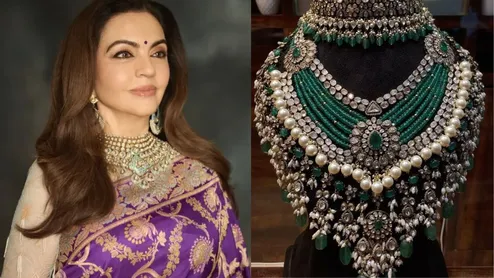
Kundan is not just jewellery; it is also 2500 years of Indian royalty into one set. From its ancient roots in the royal courts of Rajasthan and Gujarat as far back as the 3rd century BCE to its golden era under Mughal patronage in the 16th century, Kundan has outlived empires, trends and generations. The craft made Jaipur its global hub and later became a bridal staple, which is still relevant in 2026.
In today’s segment of The Jewellery Archive, we bring you the history of Kundan Jewellery and how it became the ultimate choice for bridal jewellery in today’s time.
What is Kundan Jewellery?
The word 'Kundan' means highly refined pure gold. It is a traditional form of Indian gemstone jewellery involving a gem set with a gold foil between the stones and their mount.
It is created by setting carefully shaped, uncut diamonds and polished multicoloured gemstones into a designed pure gold or faux metal base. The skeletal framework is called Ghaat, which is followed by Paadh, where wax is poured onto the framework and moulded according to the design.
Khudai, which means the stones or uncut gems being fitted into the framework, comes next. Meenakari, which is the process of painting and colouring the surfaces of metals and ceramic tiles through enameling, is also done to define the design and its intricate details.
In the next process, which is called Pakai, the gold foils are made to hold the gems, and it is finished off with the Chillai process of polishing.
Where did Kundan Jewellery Originate?
The origin of Kundan Jewellery dates back to at least the 3rd century BCE and is believed to have originated in the royal courts of Rajasthan and Gujarat. Not only has it survived till the modern fashion trend, but it is also considered one of the oldest forms of jewellery made and worn in India. It also became popular in silver for the common man in the regions of Rajasthan, Bihar and Punjab.
The Kundan Jewellery stands out among other designs because there is no indication that this technique was ever practised anywhere except in India.
The Kundan Jewellery stands out among other designs because there is no indication that this technique was ever practised anywhere except in India.
How Did Kundan Become Popular During The Mughal Era?
During the Mughal era, Kundan started off in the Rajasthan royal court and then flourished under royal patronage during the Mughal era. The Mughals ruled from 1526 to 1858 and fell in love with it, promoting it widely from the 16th century.
In Ain-i-Akbari, Akbar's chronicler Abul Fazl wrote, "Kundan is gold made so pure and ductile that the fable of the gold of Parviz which he could mould with his hand becomes credible".
This period gave birth to Kundan Meenakari, which is Kundan on the front with the intricate and vibrant enamel work on the reverse. With origins in the Rajput and Mughal eras, it is one of the earliest jewellery crafts, and Jaipur traditionally became the centre for Kundan in India over time.
Why Is Kundan Popular In Bridal Jewellery?
Kundan has been the top choice for jewellery selection for brides, and even in 2026, this trend is not dying anytime soon. From pairing with a bridal lehenga or saree to wearing it during festivities, Kundan has become an heirloom.
Unlike minimal daily wear, bridal Kundan expands into an entire collection, which includes heavy chokers, layered necklaces, matching chandelier earrings, large nose rings aka nath and maangtika too.
Its dense placement of stones and reflective gold foil go perfectly with bridal attires, whether it is a saree, suit or lehenga.
Unlike minimal daily wear, bridal Kundan expands into an entire collection, which includes heavy chokers, layered necklaces, matching chandelier earrings, large nose rings aka nath and maangtika too.
Its dense placement of stones and reflective gold foil go perfectly with bridal attires, whether it is a saree, suit or lehenga.
The usage of Kundan jewellery in pop culture contributed to its popularity as well among the common people. For instance, Aishwarya Rai wore some extraordinary kundan jewellery pieces when she played Queen Jodha in Jodhaa Akbar. Moreover, Nita Ambani, who extensively promotes Indian craftsmanship, has been seen wearing beautiful Kundan necklaces several times as well.
Kundan has shown that true craftsmanship never goes out of style. It survived the fall of the Mughals, adapted from pure gold to silver for the common man, and then reinvented itself for the Instagram bride.
(Image Credits: Pinterest)
To read more such stories, stay tuned to Her Zindagi.
To read more such stories, stay tuned to Her Zindagi.