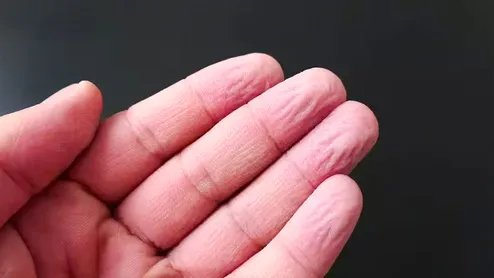
For decades, people assumed that soaking their hands in baths, swimming pools, or even the ocean caused water to be absorbed like a sponge. However, recent studies show that pruned fingers do not occur passively, as previously believed, but are a reflex controlled by the nervous system. When hands stay under water, the sympathetic nervous system activates tiny vessels in the skin that constrict, thereby decreasing the volume of tissues in the fingertips. The top layer of the skin becomes pulled inward and forms grooves similar to the tread on a tyre. According to evolutionary scientists, such grooves helped ancient people hold on to wet objects and surfaces without slipping. Drying out makes the process reversible in just a matter of seconds.
Why Do Fingers Get Wrinkly In Water?
Once your hands are in the water for a long time, small neural impulses activate a physical transformation that takes place in your body. The pads of your fingers and toes do not swell; instead, they become slightly smaller. This quick loss of tissue causes the outer surface of the skin to move inwards and form small ridges and valleys in your fingers and palms.
Do Fingers Wrinkle Because They Absorb Water?
This myth that water absorption causes the skin to swell up to the point of forming wrinkles is perhaps one of the most common health myths of all time. It is true that the outer dead skin layer (Stratum corneum) may absorb some water, but it cannot create wrinkles.
What Happens Under The Skin When Fingers Wrinkle?
The actual process that takes place underneath your skin is dependent on the following two systems of your body:
Nervous-System Reaction: Constant immersion in water triggers the sympathetic nervous system.
Blood-Vessel Constriction: Nerves transmit impulses and cause constriction of small blood vessels (known as glomus bodies) in your fingertips.
Volume Underneath the Skin: This decrease in blood flow results in reduced overall volume of the tissue underneath the outer skin layer.
Formation of Temporary Wrinkles: This happens due to the fact that although the skin area doesn’t change, its inner layer gets smaller, thus forming wrinkles.
Glabrous (or hairless) skin located at fingertips, palms, toes, and soles of your feet contains many such blood vessels.
What Is The Evolutionary Reason Behind Wrinkly Fingers?
The finding that nerve signals regulated skin wrinkling was used by the scientists to question the evolution of this phenomenon. They came up with a scientific hypothesis according to which pruney fingers were an evolutionary adaptation for early men and primates.
According to the scientific hypothesis, the wrinkles have the same function as the treads on a tyre when it is raining outside. By pressing a pruney finger onto a wet surface, the water channels will drain the water quickly, allowing the skin to come into direct contact with the surface.
Why Do Wrinkled Fingers Return To Normal After Water Exposure?
Wrinkled fingers are absolutely temporary in nature. As soon as your fingers get out of water and are dried up, your sympathetic nervous system does not send any more signals to constrict blood vessels. As a result, blood circulation is normalised in the tissues, and within 10-20 minutes the skin becomes perfectly smooth again.
Conclusion
Pruney fingers demonstrate how closely our skin and nervous system work together. Rather than an accidental side effect of soaking in a bath, water-induced wrinkling represents an active physiological mechanism that likely gave human ancestors a crucial grip advantage in wet environments.
Image credits: Freepik
To read more such stories, stay tuned to Her Zindagi.