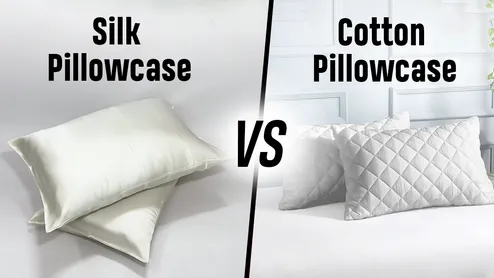
Your face and hair make contact with the pillow in about one-third of your lifetime. While it is common practice for you to apply serums, oils, and nighttime masks for your skin and hair, there is yet another critical factor that is involved in keeping your skin and hair healthy the type of fabric used for the pillow. Cotton pillowcases have been the traditional choice in the bedroom for years, yet now silk pillowcases have become very popular choices for people concerned with ageing and frizz prevention. The type of fabric that your skin makes contact with at night can affect your skin barrier and hair cuticle. This guide will walk you through all you need to know.
Silk vs Cotton: How Fabrics Impact Skin and Hair
1. Friction and Sleep Creases
Cotton: Cotton has a natural bite and roughness that causes mechanical friction with the skin. When one tosses and turns in bed, the friction pulls at sensitive facial skin, forming morning sleep lines that cause early appearance of fine lines.
Silk: Mulberry silk is made up of long continuous protein fibres that produce very low friction and a smooth surface. The face glides easily over the fabric without pulling, reducing the formation of sleep lines.
2. Hair Frizz, Tangles and Breakage
Cotton: Cotton abrades the exterior protective layer of the hair strand while you move around. It depletes the natural oils, destroys curl formation, and creates bedhead and split ends.
Silk: Silk ensures that the hair strands flow smoothly and prevents the hair from becoming frizzy at night while maintaining curl formation.
3. Moisture Absorption and Skincare Efficacy
Cotton: Cotton is naturally hydrophilic; that is, it easily absorbs oils, sweat, and moisture. This is a problem because it also absorbs your nighttime face cream, retinol, and hydrating serum that you apply just before bedtime.
Silk: Since it is much less porous than cotton, silk does not absorb your skincare products. Your skin stays hydrated throughout the night with the help of silk, and your skincare products remain where they belong.
Silk Pillowcase Vs Cotton Pillowcase
Feature |
Silk Pillowcase
Cotton Pillowcase
Surface Friction
Ultra-low glide; prevents creases and frizz
Moderate-to-high drag; causes bedhead
Moisture Retention
Does not absorb serums or natural oils
Highly absorbent; draws moisture out of skin
Hair Benefit
Preserves curls, reduces breakage and split ends
Prone to causing tangles and cuticle damage
Maintenance
Delicate hand wash or gentle cycle; air dry
Machine washable; highly durable and heat-tolerant
Cost
Investment piece (higher price point)
Budget-friendly and accessible
Conclusion
Even though nothing beats cotton when it comes to easy washing and low costs, a pillowcase made from pure mulberry silk has definite physiological benefits. Dry skin, sleep lines in the morning, and frizziness in your hair can be solved easily by changing your pillowcase to one made from silk.
Image credits: Freepik
Stay connected to read more such interesting stories on Her Zindagi.