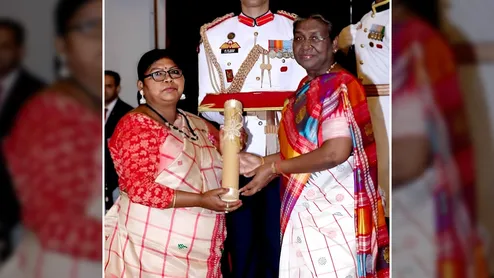
In the heart of Jharkhand, where deforestation, soil erosion, and rural poverty were a few of the problems that troubled the indigenous people, there was this one lady who made an immense change for the betterment of both nature and society. Known by the name of 'Lady Tarzan of Jharkhand,' Chami Murmu has been working towards reforestation, rural agricultural revolution, and bringing thousands of tribal women out of poverty for more than three decades now.
Starting from combating the timber mafia to establishing sustainable water conservation systems and helping create self-help eco-systems, here is how Chami Murmu changed agriculture and nature in rural Jharkhand.
Who Is Chami Murmu? Early Life And Background
Chami Murmu was born on 6th November 1971 in Bhursa, a small village where she saw growing poverty and environmental degradation first-hand during her childhood. Deforestation by mafias was rampant in those days; tribal people suffered due to poverty since trees were cut down, leading to depletion of soil moisture.
Not one to sit back and watch silently, Chami took action in the early 90s when she united 10 local tribal women to fight against tree cutting and save their forests. Against all social odds, threats by illegal loggers, and even the problem of Naxalites, which was prevalent in that region, her early social movement grew stronger and bigger with time.
How Chami Murmu Transformed Farming In Jharkhand
Before the intervention by Murmu, farming was predominantly rain-fed single-cropping due to extreme shortages of water and topsoil erosion in her region. Murmu understood that revitalising agriculture would involve the rejuvenation of the ecosystem itself:
Through organising mass campaigns for planting trees, she made sure that there was enough canopy cover to protect the soil from erosion and increase the level of groundwater.
In her NGO Sahayogi Mahila, she motivated people to construct check dams, diversions and harvesting ponds in various districts.
Due to increased availability of water, the people were able to adopt a multi-cropping system from a rainfed farming system. Those people who used to cultivate only one crop in their field cultivated paddy, vegetables, and legumes like arhar dal all through the year.
She trained farmers with hybrid methods and organic farming systems.
Her Role In Empowering Rural And Tribal Women
For Chami Murmu, environmental conservation and women’s economic empowerment have a lot in common. Through her organisation, Sahayogi Mahila Bagraisai, she institutionalised the concept of financial empowerment among tribal women as follows:
Chami Murmu created an SHG network involving over 2,800 Self-Help Groups (SHGs), thus empowering in excess of 30,000 women in over 500 villages.
She helped women obtain loans from the bank to create alternative means of income, such as poultry farming, goat rearing, pig farming, and craft making.
In addition to providing economic assistance, Chami Murmu is actively involved in fighting social vices such as witch-hunting, child marriages, and illiteracy. She runs free hostel systems and education programs for tribal girls who do not have access to education.
ALSO READ- Who Is Pabiben Rabari? The Artisan Who Built A Global Brand From Traditional Kutch Embroidery
Chami Murmu’s Environmental And Social Work
Her activism is characterised by her proactive and practical approach; her environmental accomplishments are truly awe-inspiring in scope:
In her own capacity, local women have successfully planted more than 30 lakhs trees, including Neem, Sal, Sheesham, Eucalyptus and Acacia trees, rejuvenating large tracts of denuded forest lands.
She initiated an informal community surveillance system wherein women monitor the forests around; if they see any act of illegal cutting, people gather in groups and discourage them from such activities.
The result of her efforts has been the rehabilitation of the natural habitat of wildlife in the area through the return of various birds and animals.
Awards And Recognition Received By Chami Murmu
Chami Murmu’s relentless dedication has won her acclaim at state, national, and international levels:
Indira Priyadarshini Vrikshamitra Award (1996): The Ministry of Environment, Forest & Climate Change awarded this prize to her at an early stage in her career, for her outstanding contributions to afforestation.
Nari Shakti Puraskar (2019): The President of India presented this award to her on International Women’s Day, for her pioneering efforts in women’s empowerment and community work.
Padma Shri (2024): The Indian Government bestowed upon her India’s fourth-highest civilian award, for her outstanding dedication to social work and environmental protection.
ALSO READ- Who Is Mirabai Chanu? A Girl From Small Village In Manipur Who Became Weightlifting Queen Of India
Conclusion
From the biography of Chami Murmu, one learns that local-level initiatives within the community can assist in tackling global problems like climate change, soil erosion, and discrimination against women.
Image credits: Instagram
To read more such stories, stay connected to Her Zindagi.