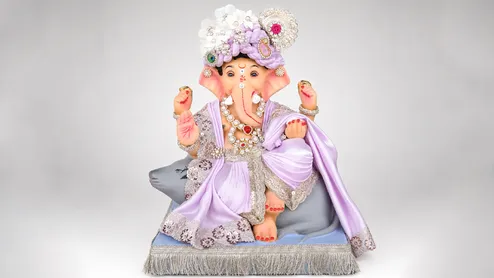
One of the most fascinating images in the imagery of Hinduism is that of Lord Ganesha, a powerful elephant-headed god seated on the back of a small mouse. One would be justified in assuming that a deity of his size should ride a powerful creature such as a lion or an elephant, but instead Ganesha chose to be accompanied by a small mouse, Mushak, as his mount. It is important to note that there is a rich mythology behind this image.
The Story Behind Ganesha And Mushak: Why The Elephant God Chose A Mouse
According to Hindu literature such as the Ganesha Purana, Ganesha’s mouse was initially a divine musician by the name of Krauncha. On one particular day at the court of Lord Indra, Krauncha unintentionally placed his foot upon that of Sage Vamadeva. Being infuriated at this act of disrespect, the sage cursed Krauncha to become a monstrous rodent.
As a monstrous rodent, Krauncha went about creating chaos everywhere, including the destruction of fields and homes. During one particular visit to the hermitage of Sage Parashara, where Ganesha was visiting, Ganesha resolved to stop the monster. He used his pasha, a divine noose, to subdue the monstrous rodent.
Being humbled by Ganesha’s divine authority, Krauncha asked for mercy. He was granted clemency, and Ganesha appointed him to be his vahana, or vehicle. However, being a monster, the mouse found difficulty carrying Ganesha’s heavy weight. Out of compassion, Ganesha became lightweight and transformed the monstrous creature into his vahana, Mushak.
Why Does Lord Ganesha Ride A Mouse Instead Of An Elephant?
While an elephant riding on another elephant would be a repetition, an elephant god riding on a mouse signifies strength, intelligence, and contradiction.
In olden days, rats were the greatest danger to agricultural activity, as they used to ruin crops and grain stores. In this way, God Ganesha shows his identity as Vighnaharta (The Remover of Obstacles), and thus he is capable of managing even such dangerous animals using intelligence. This also reflects the equality of divine creatures where size doesn’t matter in the presence of the Almighty.
What Does Lord Ganesha's Mouse Symbolise In Hindu Mythology?
The mouse quietly gnaws on whatever it finds in the darkness. Likewise, unrestrained human desires gnaw on our peace of mind and spirituality. The presence of Ganesha on the mouse indicates the mastery of one's desires rather than being controlled by them.
The rodent is always hyperactive and moves around all the time. It denotes the control of the intellect over the restless mind. Krauncha had cursed him because of his arrogance, and riding on him by Ganesha denotes the suppression of arrogance and pride under divine command.
Why Is Mushak Considered The Perfect Vahan For Ganesha?
The physical attributes of Mushak fit Ganesha's divine purpose beautifully. Mice are creatures that can wriggle through small spaces, burrow into rock, and move in complete darkness, without being detected at all.
As a remover of obstacles, Ganesha makes use of Mushak to get to those small, dark and remote corners of the universe and the human psyche where an elephant would not be able to go physically.
Ganesh Chaturthi 2026: Interesting Facts About Lord Ganesha And His Vahan
Mushak has been obtained from the Sanskrit root mus that means to steal, and denotes how unrestrained desire steals spirituality.
It is usually depicted in traditional statues sitting at Ganesha’s feet, usually gazing upward at him with his hands folded or offering him modak.
Although the mouse is the most popular vahana of Ganesha, texts such as the Mudgala Purana speak about how he used other vahanas in his different incarnations.
Conclusion
The bond between Lord Ganesha and his vahana, Mushak, transcends the mere realms of mythology. It becomes an allegory of self-control, humility, and wisdom.
Image credits: Freepik
To read more such stories, stay tuned to Her Zindagi.