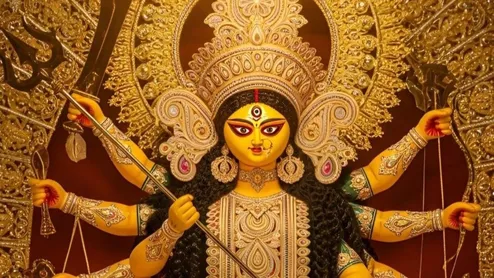
Durga Puja is not just a festival, but also an emotion. Months before the dhak beats start, the artisans across India begin a sacred process that mixes art, religion, emotions, and soil. It takes 3-4 months to bring Maa Durga to life before she is seen at pandals for devotees to worship her.
What Goes Into The Craft Of Making Maa Durga's Idol Before Puja?
Let's take a look at the beautiful and sacred craft of making the idols of Maa Durga for Durga Puja during Navratri.
1. The Sacred Soil: Punya Mati
The process of making Maa Durga's idol for Durga Puja pandals begins with collecting sacred
soil. Traditionally, artisans collect soil from the Ganga riverbed, soil from the courtyard of a brothel, and soil from seven holy places. This mix is called Punyo Mati. It is believed that without it, the idol is incomplete.
It is believed that when a man enters a brothel, he leaves his accumulated punya (purity) at the doorstep, and the soil at the entrance absorbs all this goodness. Another belief comes from the powerful symbolic act of social justice and inclusion, as it temporarily breaks rigid social boundaries.
It is believed that when a man enters a brothel, he leaves his accumulated punya (purity) at the doorstep, and the soil at the entrance absorbs all this goodness. Another belief comes from the powerful symbolic act of social justice and inclusion, as it temporarily breaks rigid social boundaries.
2. The Bamboo Skeleton
The base is made of bamboo and wood, and artisans create a frame called kathamo. This decides the posture, height and proportions of Maa Durga and her children, Lakshmi, Saraswati, Kartik and Ganesh. A prayer to Lord Ganesha is offered before work begins.
3. Straw Binding, When The Body Takes Shape
Straw is tied over the bamboo frame with jute ropes. This is the most crucial step for giving the idol its body and curves. Straw or hay is tied tightly over the bamboo frame to give the idol its basic volume and rough shape. The straw model is called 'kheror thach'.
4. Clay Layering
There are two types of clay layering while making the idol. The first layer is called Ete mati, where the clay is mixed with straw and jute. This gives the basic form. For the second layer, called Bele mati, a fine and soft clay is mixed with cloth. This makes the skin smooth, and artisans use their fingers to give Maa her expressions. They do not use tools in this process.
5. Head And Divine Expressions
The head for the idol is made separately and joined later. Eyes are the most sacred part of this process and are painted beautifully. The painting of the eyes is called 'Chokkhudaan' and is done on Mahalaya. It is believed Maa comes alive after this.
6. Colouring And Shringar
Earlier, natural colours were used while painting the idol of Maa Durga. However, artisans have moved to fabric paints. White colour is used for the base, then skin tone for the face, red for the saree and finally, the vibrant gold for jewellery. The saree is often made of real cloth, mostly draped in Bengali style.
7. Chul and Chumki: Hair and Decoration
Chul and chumki are traditional decorative materials used by artisans to style and adorn the hair and ornaments of a Maa Durga idol during Durga Puja. Jute is usually used for hair, beautifully adorned and decorated with zari and sequins. The jewellery, crown (mukut) and weapons are made of sola and zari, not metal.
8. Final Touch: The Weapons
For the final touch, the trishul, conch, chakra and lion are added to the idol of Maa Durga before it is ready for devotees. It should be noted that each weapon has its own meaning.
A single large idol needs at least three artisans working for 15-20 days. Most artisans have been doing this for five generations. They never sign their name on the idol because they believe they are just a medium; the real creator is Maa herself.