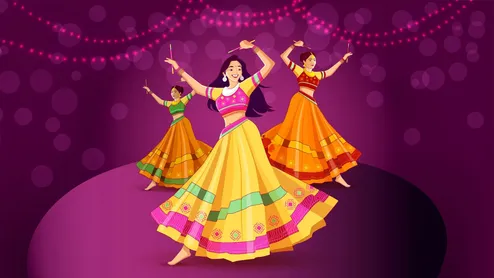
Navratri celebrations are incomplete without the infectious energy, rhythmic clapping, and festive music of Garba. If you are stepping onto the Garba floor for the first time, learning the basic footwork and hand coordination will give you the confidence to join any circular group with ease. From simple two-step counts to effortless Dandiya movements, here is your beginner-friendly step-by-step guide to mastering 7 essential Garba steps.
7 Easy Garba Steps Beginners Can Learn
Here are seven Garba steps for beginners to learn for Navratri dance 2026.
1. Basic Two-Step Garba
The foundational step for every beginner, establishing the core rhythm of Garba music.
Starting Position: Stand straight with feet shoulder-width apart, keeping knees soft and relaxed.
Foot Movement: Step your right foot out to the right side, bring your left foot to meet it. Then, step your left foot out to the left side and bring your right foot back to centre.
Hand Movement: Perform a simple, single clap in front of your chest every time your feet come together.
Direction/Count: 4-count movement (1-2-3-4), moving rhythmically side to side.
Beginner Tip: Keep your weight light on the balls of your feet to switch directions smoothly.
2. Three-Step Garba
A classic traditional Gujarati step featured in every high-energy Garba circle.
Starting Position: Stand facing the centre of the dance circle with feet slightly apart.
Foot Movement: Step forward with your right foot, follow with your left foot, step forward again with your right, and tap your left toe lightly behind. Reverse the steps to return to your starting position.
Hand Movement: Execute three distinct claps at different height levels: one low near your waist, one at chest level, and one high above your head.
Direction/Count: 6-count rhythm (1-2-3 step forward with 3 claps, 4-5-6 step back).
Beginner Tip: Time your three claps to match the beat accents rather than rushing your hands.
3. Clap Garba
Focuses on expressive hand coordination while maintaining a continuous lateral movement.
Starting Position: Stand upright with your knees slightly bent, preparing to move laterally.
Foot Movement: Take a step to the right with your right foot, cross your left foot behind it, step right again, and tap your left foot. Repeat in the opposite direction.
Hand Movement: Extend both arms outward, swinging them gently inward to clap once on count 2 and twice rapidly on count 4.
Direction/Count: 8-count side-to-side sequence.
Beginner Tip: Bend your knees slightly on each clap to give your movement a natural, bouncing rhythm.
ALSO READ- HerZindagi Navratri Dance Guide: Learn 2-Taali And 3-Taali Garba Steps In Just 10 Minutes
4. Simple Circular Garba
Helps you seamlessly blend into moving Garba circles (Gol Garba).
Starting Position: Position yourself facing counter-clockwise along the edge of the dance circle.
Foot Movement: Step your right foot forward along the circle's circumference, bring your left foot forward to meet it, and take a small diagonal step inward.
Hand Movement: Sweep both hands upward from your waist to chest height, making a soft wrist swirl followed by a gentle clap.
Direction/Count: Continuous 4-count forward progression along the circle.
Beginner Tip: Maintain equal spacing between you and the dancer ahead of you so the circle moves uniformly.
5. Side-Step Garba
A low-impact, rhythmic step perfect for pacing yourself through long dancing sessions.
Starting Position: Stand sideways relative to the centre of the circle, feet together.
Foot Movement: Step your right foot out wide to the right, drag your left foot to touch, then tap your right toe in place before switching sides.
Hand Movement: Sway both arms in a wave-like motion from left to right, snapping your fingers or clapping gently at the end of each stretch.
Direction/Count: 4-count lateral sway (Right-Touch, Left-Touch).
Beginner Tip: Focus on the sway of your torso to make this simple footwork look fluid and stylish.
6. Turn Garba Step
Adds flair and movement to your routine by introducing a controlled, half or full spin.
Starting Position: Stand facing forward with feet together.
Foot Movement: Step out with your right foot, pivot on the ball of your left foot to make a 180-degree turn, step down with your right, and complete the full 360-degree rotation.
Hand Movement: Raise both hands overhead, snapping your fingers at the peak of the spin, and finish with a chest-level clap as you complete the turn.
Direction/Count: 4-count spin sequence.
Beginner Tip: Keep your gaze focused on a fixed point ahead as long as possible before spinning to avoid dizziness.
7. Easy Dandiya Step
A beginner-friendly movement pattern for playing with sticks (Dandiyas) in paired lines or circles.
Starting Position: Stand facing your partner, holding one Dandiya stick firmly in each hand at chest height.
Foot Movement: Step forward with your right foot to strike, step back to your starting point, then step left diagonally to strike with the adjacent dancer.
Hand Movement: Strike your right-hand stick against your partner's right-hand stick on count 1, strike your left-hand stick on count 2, and cross-strike both sticks on count 3.
Direction/Count: 4-count partner interaction.
Beginner Tip: Hold your Dandiya sticks near the base for better grip control, and strike lightly at chest height.
ALSO READ- How To Do Dhodhiya Garba: Step-By-Step Dance Guide For Beginners To Master The Traditional Steps
Conclusion
By practising these seven basic steps, you will be able to gain confidence, rhythm, and coordination while dancing. Begin slowly, keep pace with the beats of the dhol, and revel in the festivities as you spin through the evenings of Navratri.
Image credits: Instagram
To read more such stories, stay tuned to Her Zindagi.