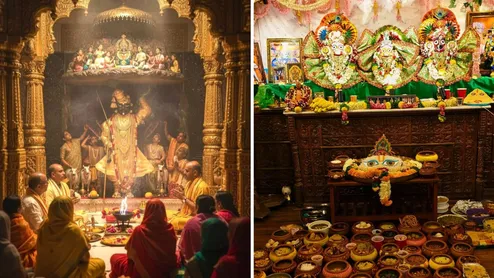
Govardhan Puja is the fourth day of the Diwali festivities. This year, it falls on Tuesday, November 10, 2026, and the morning puja muhurat in New Delhi runs from 6:39 AM to 8:49 AM. The date is November 10 because Pratipada Tithi is still on at sunrise that day, so the festival follows the Udaya Tithi rule. Some calendars list November 9, so check your local panchang for exact timings.
On this day, devotees offer Lord Krishna a huge spread of food called 56 Bhog. Here is the story behind it.
Why Is 56 Bhog Offered To Lord Krishna?
The tradition goes back to the story of Govardhan Hill in Braj. As the legend goes, the people of Braj used to worship Lord Indra for good rains. Krishna asked them to worship Govardhan Hill instead, because the hill gave them grass for the cows, fruits, water and shelter.
An angry Indra sent heavy rain and storms over Braj. Krishna lifted Govardhan Hill on his little finger and held it for seven days. The villagers and their cattle took shelter under it.
For those seven days, Krishna did not eat anything. Mother Yashoda was said to feed him eight times a day. When the rain stopped and the hill was put back, the people of Braj were worried about the little boy who had gone hungry for a week.
So they made up for every missed meal. Eight meals a day for seven days comes to 56. That is how 56 Bhog began.
What Is The Meaning Of 56 Bhog In Hindu Tradition?
The number 56 stands for love, gratitude and care. The offering is not about showing off. It is a way of thanking the one who protected the community.
Another belief links the number to the lotus of Goloka, where Krishna is said to sit with Radha. The petals of that lotus are believed to be arranged in layers, and the 56 dishes stand for each of those layers.
What Is Annakut And How Is It Linked To 56 Bhog?
Govardhan Puja is also called Annakut, which roughly means a mountain of food. Families and temples arrange a large variety of dishes in the shape of a hill. The food is first offered to Krishna and then shared as prasad.
Many households make a small Govardhan hill out of cow dung. It is decorated with flowers, diyas and tiny figures of cows. People then walk around it and offer food and prayers.
What Is Included In The 56 Bhog Thali?
There is no single fixed list. It changes from region to region and from temple to temple. A typical thali includes sweets like kheer, rabri, laddoo, jalebi, malpua and halwa. Savoury items like puri, kachori, khichdi and kadhi are also part of it.
Fruits, dry fruits, chutneys, pickles, papad, curd, butter and milk-based items fill the rest. Makhan mishri is a must for many families, since butter is Krishna's favourite. A tulsi leaf is placed on the food too, as an offering without tulsi is considered incomplete.
Where Is Govardhan Puja Celebrated The Most?
The celebrations are biggest in Mathura, Vrindavan and Govardhan. Temples in Nathdwara in Rajasthan, ISKCON centres and many Vaishnav temples across India put up grand Annakut displays. In Gujarat, the day is also marked as the start of the new year.
Can You Offer 56 Bhog At Home?
Yes, and it does not have to be a big affair. Many families offer a smaller version with whatever dishes they can prepare. The idea is to offer the food with devotion, not to count each item perfectly.
You can make a few sweets, a couple of savoury dishes, fruits and dry fruits. Place everything before the Krishna idol or picture, add tulsi leaves and offer it during the puja. Share the prasad with family and neighbours afterward.
About The Ritual
Beyond the ritual, the festival carries a simple message. Krishna asked people to respect the hill, the rivers and the cattle that kept their lives going. Many see it as an early lesson in valuing nature.
The 56 Bhog adds the other half of the message: gratitude. It is the community saying thank you, one dish at a time.
(Image Credits: Pinterest)
Stay tuned to read more such stories on Her Zindagi.