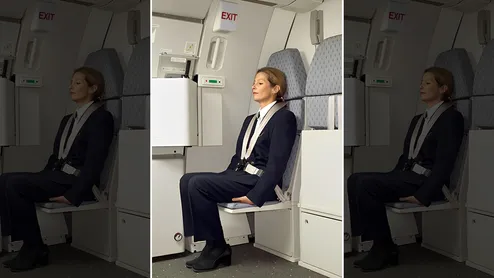
Assuming that you are a frequent traveller, you might have noticed that the flight attendants usually assume an unusual position on their jump seats when taking off and landing; that is, they put their palms against their thighs. What many people do not know is that this is not just some habit or way to keep themselves warm, but it is actually a safety procedure in the aviation sector. This particular technique is known as the ‘brace position.’ Why do flight attendants sit on their hands?
Ever Wondered Why Flight Attendants Sit On Their Hands During Takeoff And Landing? Facts Explained
1. What Is the Flight Attendant ‘Brace Position’?
During takeoffs and landings, which are the times when airline emergencies happen most often, the cabin crew sit in designated jump seats. They do not casually rest their hands in their lap; rather, they strap their multipoint harnesses, sit up straight, place their feet firmly on the ground, and put their hands palms up under their thighs or directly on their knees.
2. Restricting Body Movement During Impact
It is important for one to sit with your hands for the purpose of ensuring that the body is immobilised and positioned firmly. In case of any turbulence, harsh braking, and in an emergency landing situation, the force of inertia could be very strong and could make the extremities move around wildly. Sitting with hands helps in preventing this problem.
3. Protecting Hands for Emergency Operations
In the case of an aeroplane emergency, the job of cabin crew is to open bulky exit doors, inflate escape slides, and assist hundreds of people in getting to safety. In the event that one of the crew members gets hurt in the hands and arms in a rough landing, their capacity to use emergency equipment is greatly hindered.
4. Conducting Mental Reviews
Sitting in this braced position, however, the flight attendants are not idle, but performing the mental safety checklist (also known as the ‘silent checklist’). In these critical moments, the flight attendants mentally go through the steps of an emergency response, consider the exit door operations, look for nearby emergency equipment, and possible exit paths for passengers.
Conclusion
A seemingly basic practice of sitting is actually a highly engineered safety procedure practised globally by airline pilots. Flight attendants sit on their hands to ensure that, in case of any emergency situation, they are not injured and hence ready to assist you. Next time when you travel in an aircraft, don’t worry about anything because your flight crew is completely prepared for all situations.
Image credits: Freepik
Stay tuned to read more such stories on Her Zindagi.