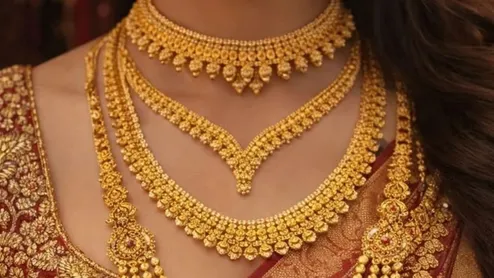
One of the most common questions I am asked is whether jewellery counts as an investment. I love jewellery. I say this without apology. I love the weight of a good piece, the way light moves through a well-cut stone, the craft and intention behind something made to last generations. But love and investment are two different things, and confusing them has real financial consequences.
If you asked me to choose between a diamond necklace and a fifteen-year SIP, I would choose the SIP. Every time.
That is not a contradiction. It is a distinction. And it is the most important thing I want to say to you this Dussehra, as gold is polished and jewellery comes out and someone in every Indian home says: "Sona toh investment hai." Gold is an investment.
Is it? Or is it something else entirely?
There is a difference between gold as a metal and gold as jewellery. That difference has financial consequences that most families never fully examine.
Here is why.
When you buy gold jewellery, you pay for the gold itself, priced by weight. But you also pay making charges, which are the cost of the labour and craft that shaped the gold into what it is. These making charges range from roughly eight percent on simple machine-made pieces to thirty-five percent or more on intricate handcrafted designs. When you sell that jewellery, you get the gold value back. You do not get the making charges back. They are gone the moment you walk out of the shop.
So on the day you buy a necklace and the day you sell it, even if the gold price has not moved at all, you have already lost those making charges. The gold has to appreciate enough just to recover that cost before you are even at zero.
This is not an argument against jewellery. Jewellery has value that a mutual fund will never have. It is worn. It is passed down. It carries the memory of a mother's wedding, a grandmother's hands, a daughter's first Diwali. That is real. No spreadsheet captures it.
But the mistake is calling it an investment when you mean it is a treasure. Those are not the same thing, and confusing them leads families to feel financially secure when they are actually quite concentrated in an asset that is illiquid, depreciates in form even as gold appreciates in price, and requires safe storage, insurance, and care.
So what is the smarter way to own gold as a financial asset?
Gold ETFs are the answer most financial advisors would give, and for good reason. A gold ETF is a fund that holds physical gold in a regulated vault on your behalf and trades on the stock exchange like a share. One unit typically represents approximately one gram of 99.5 percent pure gold. You buy and sell at the prevailing gold price, with no making charges, no storage worry, no locker rental, and no risk of someone questioning your purity when you want to sell. The expense ratio of most gold ETFs in India is around half a percent annually, which is a fraction of what making charges cost you upfront on the day of purchase.
Some of the well-known gold ETFs in India include Nippon India ETF Gold BeES, SBI Gold ETF, HDFC Gold ETF, and ICICI Prudential Gold ETF. These are large, established funds with good liquidity, meaning you can buy and sell easily on any trading day.
To buy a gold ETF, you need a demat account, which is the same account used to hold shares. If you have one, you can start with as little as one unit, which is roughly the price of one gram of gold today. You can also set up a systematic investment, buying one unit every month, which is the gold equivalent of a SIP.
If you do not have a demat account and are not ready to open one, there is another route. Gold Fund of Funds are mutual funds that invest in gold ETFs on your behalf. You can start a SIP in a gold fund of funds with as little as five hundred rupees a month, through any mutual fund platform, exactly as you would with any other mutual fund. No demat account needed. The returns track gold prices, and the process is as simple as any other SIP you may already have running.
Is gold a good investment at all?
This is worth asking honestly.
Gold does not generate income. It pays no dividend, no interest, no rent. It appreciates when people are afraid, when inflation is high, when currencies weaken. Over the very long term, gold has broadly kept pace with inflation in India, which makes it a reasonable hedge but not a wealth creator in the way that equity can be over decades. If I had to choose between a diamond necklace and a fifteen-year SIP in a diversified equity fund, I would take the SIP. But I would still want some gold in the picture, because portfolios need balance, and gold moves differently from equity and debt.
The practical guidance is this: own gold if you love it, if it is part of your family's tradition, if it gives you comfort. Wear it with joy. Just separate in your mind what is jewellery and what is investment. The jewellery is a treasure. The financial exposure to gold, if you want it, is better held in a form that costs you no making charges and that you can sell in a moment without negotiating purity.
This Dussehra, when the gold comes out and is admired, enjoy every moment of it. And separately, in your financial plan, decide whether gold belongs there, how much, and in what form.
That is the question Laxmi would ask.
This column is for educational purposes only. Please consult a qualified financial professional before making investment decisions.
Write to us at iamolaxmi@gmail.com. We read every letter.
(Image credit: Pinterest)
Saty connected to read more such stories on Her Zindagi.