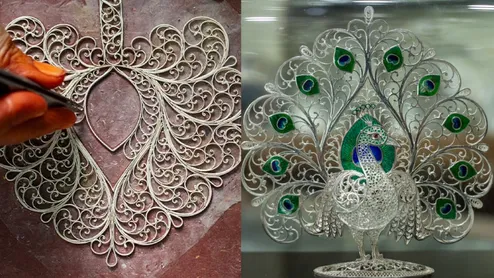
India is a global destination for rich art and culture, with the world drawing inspiration from our heritage. One of the treasured art forms is 'Tarakashi', which is a highly skilled art form from Odisha of creating jewellery. It is a type of silver filigree, which is an intricate metalwork, from Cuttack, a city in Odisha. More than 500 years old, the art form has stayed relevant even today, showcasing the talent of Indian artisans.
What is Tarakashi?
This 500 years old art form is done by local artisans on the eastern shores of Odisha. To make tarakshi jewellery, delicate and intricate work is done on silver, where fine, hand-drawn metal wires are twisted, shaped and soldered into lace-like patterns.
The 'tarakashi' comes from taar, which means wire and kashi, which means artwork or inlay.
Why Is Tarakashi Called Silver Lace Jewellery?
Tarakashi is called silver lace jewellery and even woven moonlight as artisans use very thin and fine silver wires that are twisted into delicate and web-like patterns to make them resemble like lace fabric.
The artistans work with mostly pure silver and start the process by taking a lump of silver, placing it into a small clay pot, and putting the two into a bucket full of hot coals. It is melted for about 10 minutes, then poured into a small, rod-like mould and cooled by submerging the rod in water.
Then comes a long and physically demanding process of placing the melted silver into a machine that will press the rod into a long, thin wire. The wires are then strung together to make beautiful designs. This long process takes a lot of hard work by the artisans, making the jewellery even more precious. The designs can be floral, paisley and even geometric.
What Are The Popular Tarakashi Jewellery And Decorative Pieces?
From bridal toe rings, vermilion boxes, anklets, necklaces and brooches, tarakashi jewellery is used for several occasions and is relevant even after 500 years. Moreover, Odissi dancers also wear this jewellery, which is usually a replica of the Taj Mahal and Konark Temple.
What makes the tarakashi art form even more special is that it is used to make massive backdrops called 'Chandi Medhas' during Cuttack's Durga Puja. At Chandni Chowk, the entire crown and accessories of one of the idols of Goddess Durga are made of silver.
Motifs of animals, birds, flowers and even handbags are made in tarakashi. Scenes from the Mahabharata, still depicting the chariot of Arjuna driven by Lord Krishna, are some of the top choices to make in this art form.
The 500-Year-Old History Of Tarakashi In Odisha
The timeline of the tarakashi art form is not entirely fixed. Some say that its roots go back to the 13th century, as the craft became popular during the Mughal era.
After this, royalty and wealthy merchants sought after the delicate silver and gold works. In 1897, Utkal Gourab Madhusudan Das also promoted Odisha Art Wares to make this art form global.
Is Tarakashi Art Still Relevant?
Even though the tarakashi art form is still very much relevant, it has been struggling to survive. The massive surge in silver prices globally has affected the industry, with increased tariffs and artisans struggling to buy silver.
Meanwhile, the population of artists making tarakashi is also declining. This work requires immense precision, time, and eyesight, but the wages for artisans are low, making them struggle to make their ends meet.
The market is also now flooded with cheaper, mass-produced, machine-made imitations that can mimic this art form. There is now a heavy dependence on Durga Puja and other festivals to make Chandi Medhas and earn revenue.
There is still hope for this dying art form. Cuttack Rupa Tarakashi received the Geographical Indication (GI) tag on March 2, 2024, showcasing the appreciation for this 500 year old art.
Conclusion:
Tarakashi is not just jewellery; it is Odisha and India's heritage woven in silver. Even though jewellery can be easily accessible through machines, there is nothing like handcraft, where each piece of Tarakashi holds months of patience and centuries of history.
(Image Credits: Instagram)
To read more such stories, stay tuned to Her Zindagi.
To read more such stories, stay tuned to Her Zindagi.