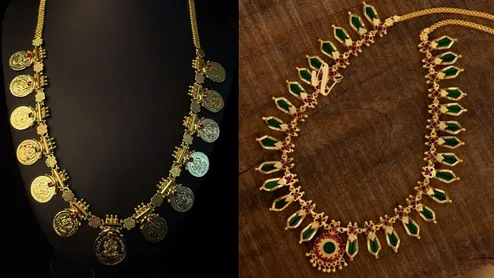
Kerala's jewellery culture is not just about luxury, but also about legacy and rich heritage. Two designs that have dominated women's jewellery collection since centuries are: Kasu Mala and Nagapadam. Know all about these beautiful designs, how they originated, and how they are still relevant among modern trends.
What is Kasu Mala?
Kasu Mala is a traditional South Indian necklace, made by stringing small coin-shaped motifs closely together. For the unversed, 'Kasu' literally means 'coin' and 'Mala' means 'necklace' or garland.
The individual coins overlap and are embossed with the image of Goddess Lakshmi or any Hindu temple motifs. Although it is traditionally crafted from gold, some precious stones can also be embedded.
It is considered highly auspicious and also a symbol of Goddess Lakshmi's blessing for wealth and food fortune.
ALSO READ- What Is Tarakashi? Inside Odisha’s 500-Year-Old Craft Turning Pure Silver into Fine Lace Jewellery
What are the origins of Kasu Mala?
The origins of Kasu Mala go back to the Chola and Vijayanagara empires. But it is also believed that its roots dates back to ancient India too, due to the practise of stringing metallic and gold coins together as wearable wealth and temple offerings.
As per reports, the Vedas have mentioned ornaments called 'nishka greeva', where nishka was the currency. Some historical sculptures are also seen wearing jewellery similar to Kasu Mala.
Later, during the Chola, Pandya, Chera, and the Vijayanagara Empires, this type of necklace became more popular. The coins were reportedly actual gold currency and were stamped with Goddess Lakshmi. It was a symbol of prosperity and status for royal families.
What is Nagapadam design for jewellery?
Nagapadam is also a traditional design for making necklaces, with snake-hood shaped pendants that are usually made with green and red stones in gold.
The word 'nagapadam' translates to snake's hood, where naga means snake, and padam means hood. It also pays tribute to serpent worship, which holds deep religious and cultural significance in Kerala.
Moreover, the serpent is also considered a sacred symbol of divine grace, fertility, and protection and is believed to ward off negative energies and bring good fortune.
What are the origins of the Nagapadam necklace?
Originating in Kerala, the Nagapadam necklace is rooted in the region's ancient heritage of serpent worship and sacred groves. As in Dravidian culture, Nagas were considered sacred and worshipped; people believed that pleasing the Naga would protect their family from curses and bring children. This belief gave birth to the Nagapadam design.
However, between the 16th-18th century, this design was popularised by the royal families of Travancore and Cochin. The temple jewellery for Goddess Durga and Bhadrakali started including Nagapadam, and royal women started wearing it as a symbol of protection and power.
How have Kasu Mala and Nagapadam been relevant amid modern trends?
Both Kasu Mala And Nagapadam have become the ultimate bridal fashion trend in the modern world, along with their popularity for weddings. Popular brands have made them more accessible to the general public.
Conclusion:
Today, Kasu Mala and Nagapadam are not just grandmothers' jewellery, but they are heirloom and fashion statement. The designs have survived centuries and have still managed to stay relevant today.
(Image Credits: Pinterest)
To read more such stories, stay tuned to Her Zindagi.
To read more such stories, stay tuned to Her Zindagi.