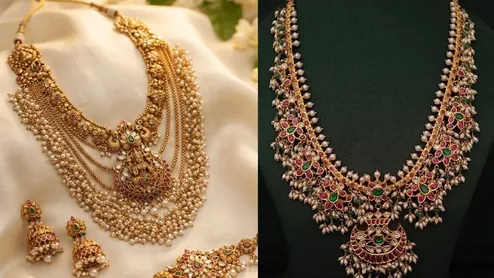
It is quite well known that the grandeur of a South Indian wedding cannot be matched, especially in terms of beautiful jewellery, which is a piece of art in itself. One of the trending jewellery pieces that is stealing the spotlight in every bridal trousseau is the Guttapusalu necklace.
In today's segment of The Jewellery Archive, we take you behind the scenes of the craftsmanship of Guttapusalu, which has dominated bridal jewellery trends without you even realising.
What is a Guttapusalu Necklace?
In Telugu, Gutta means cluster or a shoal of small fish, and Pusalu means beads. The necklace is famous for bunches of tiny rice pearls hanging like grapes from a gold base. Its designs seem to be like dangling pearl drops swaying together, mimicking a small school of fish or bunches of grapes.
ALSO READ- The Jewellery Archive: What Are Junbiri And Dholbiri? Know All About Assam's Finest Silver Ornaments
How did the Guttapusalu Necklace originate?
Originated in the 18th century near the pearl-fishing Coromandel coast in Andhra Pradesh, it was made for gods and was a part of temple jewellery. The traditional Guttapusalu features a central pendant of Goddess Lakshmi seated on a lotus, surrounded by mango motifs, floral designs, kemp stones in red and green, and a fringe of cascading pearls. Later, queens and aristocrats in royal courts also adapted this beautiful neckpiece, and it was crafted in solid gold for them.
According to Krishna Jewellers, the region had everything a jeweller could dream of: natural pearls from the Gulf of Mannar, gold from South India's mines, and Golconda: the world's most storied diamond market.
ALSO READ- The Jewellery Archive: How Sacred Gold Made For South Indian Temples Became A Global Bridal Trend
What are the materials used in Guttapusalu?
Even though Guttapusalu mainly focuses on beads and pearls, it is much more than that.
Usually 92.5 silver with 22kt gold polish or a matte antique gold finish for that vintage temple look.
The classic red and green stones are used to make necklaces to give a royal look, and they also symbolise prosperity.
Pearls, looking like rice, are put together in clusters that give it movement and lightness.
Along with pearls and beads, the beautiful motifs of Goddess Lakshmi, Lord Krishna, or mango-paisley are used as central pendants that give it spiritual significance.
The classic red and green stones are used to make necklaces to give a royal look, and they also symbolise prosperity.
Pearls, looking like rice, are put together in clusters that give it movement and lightness.
Along with pearls and beads, the beautiful motifs of Goddess Lakshmi, Lord Krishna, or mango-paisley are used as central pendants that give it spiritual significance.
Why are brides obsessed with Guttapusalu in 2026?
Guttapusalu necklaces are the true heirloom and are designed to be passed down. Brides usually go for jewellery that tells a story, and this piece has centuries of culture woven into it.
Moreover, this royal looking statement neckpiece also go with every ethnic wear, whether it is a Kanjeevaram, Banarasi or simple silk cotton saree for a festival. Pearls in a Guttapusalu necklace also hold a special significance for purity and prosperity in South Indian tradition, whereas the fish-like clusters evoke abundance.
To keep a good care of Guttapusalu jewellery, store it in an airtight box with anti-tarnish properties, away from perfumes and moisture. Remove before applying makeup to maintain its golden polish.
A genuine 92.5 silver and gold Guttapusalu set starts at Rs 35,000 and goes up to Rs 1,20,000 for heavy bridal harams with real kemp work. Always buy from trusted silver temple jewellery stores that provide purity certificates.
Conclusion:
The Guttapusalu necklace proves that some trends don't fade, they evolve. What started as temple jewellery for Andhra queens has now become the statement piece for every modern South Indian bride who wants heritage with elegance.
(Image Credits: Pinterest)
To read more such stories, stay tuned to Her Zindagi.
To read more such stories, stay tuned to Her Zindagi.