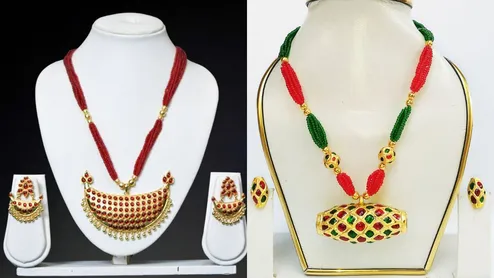
Indian craftsmanship has been well known worldwide, but many are not aware of Assam's traditional jewellery and how it has survived from over six centuries. Leading this are two of the most iconic statement pieces: Junbiri and Dolbiri. Not only do these jewellery designs showcase the rich culture of ancient India, but also symbols of grace and the power of Assamese heritage. Here’s everything you need to know about Assam’s finest heirlooms.
What is a Junbiri?
Junbiri is one of the most well-known Assamese ornaments. Shaped like a crescent or half moon, the term derives from jun (moon). 'Biri' means a small pendant or bead motif.
It is also considered a timeless heirloom, often gifted to a daughter or bride to mark important life milestones and passed down through generations. The full set usually includes the Junbiri pendant, matching Junbiri earrings, and is worn with the traditional mekhela chador.
What is Dhulbiri?
Dhulbiri is a necklace with a pendant in the shape of a dhol, the traditional drum played during Bihu celebrations. Inspired by the sound of Bihu, its creation is unique, drawing upon the musical heritage of the State rather than on nature or royal symbols alone.
Made in gold, it is worn by people in Assam during special occasions like weddings and Bihu dance performances. It is not your regular traditional jewellery design, but it stands out among others because of its cylindrical, drum-like shape.
The term 'motabiri' was historically used to refer to a large, drum-shaped ornament made without the use of gemstones. The ornament was worn only by men, but the trend changed over the centuries, and it is now a popular jewellery piece for women in today's time.
What are the origins of Junbiri and Dhunbiri?
The tradition of making jewellery in Assam was prominent since ancient times, as the use of gold has been mentioned in some early scriptures like the Arthashastra, the Kalika Purana, and Yogini Tantra.
Earlier, Assamese jewellery had depictions of regional flora and fauna, musical instruments, and objects of everyday life, especially in gold. Rulers and members of the royal families of the kingdoms of Assam also wore garments and ornaments made of gold, as it was produced abundantly within the region.
The jewellery pieces were not just limited to necklaces; kings and queens also wore anklets, gold rings with gems, robes embroidered with gold thread, and pearls suspended from the ears with gold thread.
ALSO READ- The Jewellery Archive: How Sacred Gold Made For South Indian Temples Became A Global Bridal Trend
During the reign of the Ahom kingdom in the 15th century, more significance was given to making the jewellery craft prominent.
Over time, artisans redesigned it to be lighter and more versatile, making it a favourite contemporary statement necklace for women in Assam who want to wear their culture with pride. It represents rhythm, strength and celebration.
How is Assam Jewellery Relevant in 2026?
In 2025, traditional Assamese jewellery, known as Axomiya Gohona, received the Geographical Indication (GI) tag from the Government of India for its unique craftsmanship and cultural heritage. It was facilitated by organisations such as the Gems and Jewellery Promotion Council of Assam and supported by the Assam Science and Technology and Environment Council (ASTEC).
In an era of fleeting trends, Assam's Junbiri and Dholbiri are timeless. With the GI tag finally protecting their authenticity, they are not just pieces of jewellery to wear, but stories to preserve and pass on.
(Image Credits: Pinterest)
To read more such stories, stay tuned to Her Zindagi.
To read more such stories, stay tuned to Her Zindagi.