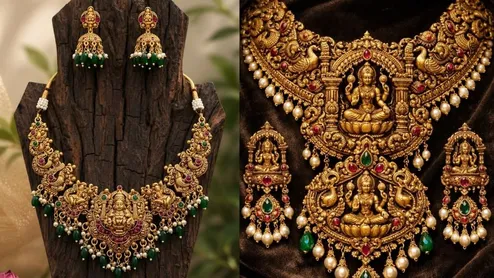
From the beginning of Indian civilization, jewellery has been more than an adornment, as it has become a legacy of a rich culture. Despite Western trends dominating around the world, India has clung to its heritage, and that legacy can be seen in Temple Jewellery, which remains a pivotal part of South Indian culture even today.
In today's segment of The Jewellery Archive, we bring you the intriguing history of Temple Jewellery and how it went from adornments for gods and royals to South Indian bridal fashion.
What is Temple Jewellery?
Dating back to the 9th- 12th centuries, temple jewellery is a traditional style of ornamental art that originated in South India during the Chola and Pandya empires. Hindu deities and temples are usually depicted on this jewellery. It has also remained an essential part of South Indian bridal trousseaus across the centuries.
Notably, the designs that are featured on them are mostly Hindu gods and goddesses like Goddess Lakshmi or motifs of peacocks, flowers, and elephants.
Made from gold or silver, the temple jewellery are handcrafted with perfection. Artisans take inspiration from several ancient temples across India to create them, and no gemstones or diamonds are included.
What are the origins of Temple Jewellery?
During the reign of the Chola Dynasty between 9-13th century, the trend of temple jewellery peaked. It was crafted by skilled goldsmiths, who were hired by royalty and was made to be offered to temples. The idols of deities adorn these, hence the name temple jewellery.
Later, replicas were made for devadasis as a sign of devotion, and it was later adapted by the royal families too.
It was even adorned by dancers performing traditional arts like Bharatanatyam but they wore replicas of these divine ornaments. This was done to help audiences instantly recognise mythical characters.
Over time, families began commissioning similar handcrafted gold pieces for weddings and they became generational heirlooms.
How Did Temple Jewellery Become A Bridal Trend?
South Indian brides consider a full temple set auspicious, which comprises a Lakshmi Haaram (long necklace), choker, jhumkas, vanki (armlet), maang tikka, and oddiyanam (waist belt). It is also believed to bring good luck and prosperity. It is mostly crafted in 22K gold because its purity and warm and rich tone honour the sacred origins of the craft.
As temple jewellery is made with treasured materials, it needs care. Avoid contact with water or perfume due to the fact those can harm it. You can use a soft material to remove dirt and sweat from it.
Celebrities in Temple Jewellery:
Several celebrities have be seen wearing temple jewellery, but Rashmika Mandanna adopted it at her wedding as well, by Shree Jewellers. The statement pieces included a choker layered with harams, jhumkas, champasaralu, mathapatti, bangles, bajuband, waist belt, anklets, nose pin, hathphool, and the unmistakable jada billa.
Conclusion
Temple Jewellery was first made for Gods, not for people. Slowly, this trend moved from royals to common people and has now become a major part of South Indian bridal fashion. Even today, its designs are the same: big gold necklaces, mango-shaped earrings, and kasina mala. It is heavy, antique, and full of culture. Temple jewellery is not just a fashion trend; it is the faith, culture, and heritage of ancient India that has been preserved for centuries.
(Image Credits: Pinterest)
To read more such stories, stay tuned to Her Zindagi.