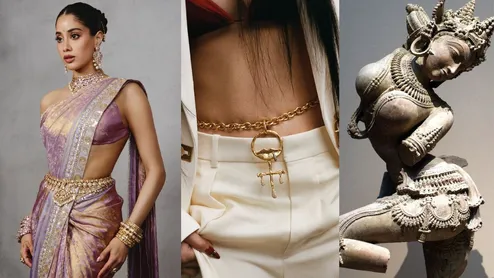
Long before it was a waist belt, there was a kamarband. For centuries, Indian women wore it as a heavy silver or gold kamarband, which was a status symbol, a reflection of marital prosperity and bridal Solah Shringar. What was once traditional temple and royal jewellery is now back in 2026 as the modern waist chain and fashion waist belt.
In today’s segment of The Jewellery Archive, we take a look at kamarband and how this ancient Indian ornament transformed into a waist chain or cummerbund.
Kamarband History: Tracing The Origins Of India’s Waist Jewellery
Kamarband, the waist ornament, goes back to over 4000 years in ancient Indian civilization, and its traces can even be seen at ancient temples, idols, and carvings. Derived from the Persian words 'kamar', means waist, and 'band', belt, it had several identities and evolved from a symbol of fertility to royalty to modern fashion.
Many ancient sculptures and artifacts across different temple sites in India have shown metallic waist chains and jeweled belts, indicating that they were widely worn as early as the Indus Valley civilization. It symbolised prosperity, fertility, and marital status in ancient India. Elaborate gold and silver kamarbands were also adorned by kings, queens, and nobility to display wealth and social hierarchy.
Not just in India, the use of waist chains can be traced back to 7000 years in Ancient Egypt. However, it was not just limited to women, as men wore them too. Lord Krishna is also depicted wearing a waist chain in several prominent paintings.
Later, the Mughal era adopted the kamarband too, and it was already a part of their garment for royal families. For Mughals, it was a form of waistband known as the patka or katzeb before it became strictly a metal ornament.
These sashes were created from the finest silk, brocade, muslin, or gold thread and meticulously embroidered with delicate floral motifs using zardozi and pearls. Later, emperors like Shah Jahan started using kamarband as a jewellery piece and paired them with the waist sash.
How Did The Kamarband Evolve Into The Modern Waist Chain?
Due to colonial exchange, the traditional kamarband transitioned into the modern waist chain and has now been revived again.
In the 1960s, the waist chains slowly started shifting from being a traditional ornament to a hippie movement as people borrowed from Indian influences. Rather than heavy metallic, gold, or silver belts with detailed designs, people started wearing plain silver chains draped over their jeans or skirts.
They were later seen in the runways in the 90s and also became a major part of fashion in the Y2K era for being paired with low rise jeans.
They were later seen in the runways in the 90s and also became a major part of fashion in the Y2K era for being paired with low rise jeans.
How Did Kamarband Become Known As Cummerbund?
It is believed that the British military officers adopted kamarband into their garments during the 19th century after being influenced from the Mughals. However, they did not wear them as jewellery but as a fabric sash.
Soon, the British anglicised the word to 'cummerbund’, and it soon became an important piece of clothing for American high society at the Tuxedo Club in New York. It is now an important part of Western black-tie formal attire.
ALSO READ- The Jewellery Archive: What Are Junbiri And Dholbiri? Know All About Assam's Finest Silver Ornaments
Why Is Kamarband Making A Comeback In Contemporary Fashion?
Kamarband, in India, is still a major part of traditional fashion, being paired with ethnic attire like saree, lehenga. It is also a pivotal part of bridal attire, especially for South Indian brides.
Talking about its addition to modern fashion, it has made a comeback in 2026 as many fashion eras have dominated the new trends. As Y2K has also made a comeback, chunky waist belts and chains have returned too.
Several celebrities like Kim Kardashian, Hailey Bieber and many more have been seen sporting waist chains.
Talking about Indian celebrities, Priyanka Chopra and Janhvi Kapoor were recently seen donning kamarbands too.
From temple jewellery to daily wear, the women's kamarbandh has never gone out of style; it has only changed form. In 2026, the waist belt is not just to hold a saree or accentuate a waistline; it is heritage jewellery turned into power fashion for women.
(Image Credits: Instagram, Pinterest)
To read more such stories, stay tuned to Her Zindagi.