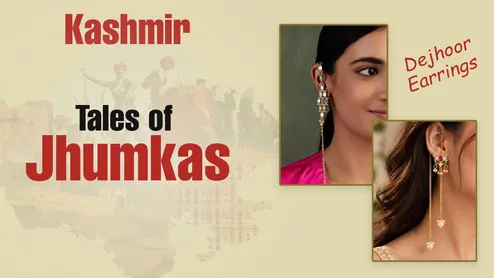
A Kashmiri Pandit bride does not get a mangalsutra tied around her neck. She gets something hung from her ears. And for the rest of her life, that one piece tells everyone she is married. It is called the dejhoor.
What Is a Dejhoor? The Sacred Kashmiri Equivalent of a Mangalsutra
If you grew up outside Kashmir, you probably have not seen one up close. It is not like a normal jhumka. The dejhoor, also written as Deji-Hor, is a long, dangling ear ornament that Kashmiri Pandit women start wearing from the night before their wedding. And then, traditionally, they just never take it off. Think of it as Kashmir's answer to the mangalsutra. Same job, completely different language.
It is not worn by Kashmiri Muslims, and not by women from other Hindu communities either. It is only worn by Kashmiri Pandits. A full set has three parts. There is a chain that goes over the ear called the ath, the hexagonal pendant in the middle, and a tiny dangling piece at the bottom called the athur. Together, they make the whole thing.
The Ancient Origin and Sacred Geometry Behind Its Hexagonal Shape
This is my favourite part. The dejhoor is never round, never square, never a random shape. It is always hexagonal. Always gold. Always with a small dot in the centre. Because it is not really jewellery. It is a yantra.
In Kashmir Shaivism, that hexagon is Shiva and Shakti together. Consciousness and energy. The dot in the middle is balance, a steady married life. It is also not just about the couple. When a woman wears it, it is meant to say two families have now become one. And this is not a new tradition.
There is a 10th-century stone sculpture in Srinagar, at the SPS Museum, called Birth of Buddha. If you look closely, Mayadevi and her sister Prajapati are wearing something that looks exactly like a dejhoor. Same way, same place on the ear. That is more than a thousand years ago.
Let that sink in. Women were wearing this before most of the jewellery we know today even existed.
The dejhoor does not just appear on the wedding day. It has its own ceremony. A day before the wedding, there is a ritual called Devgoan. The bride's mother gives her daughter the dejhoor. It hangs from the upper ear on a red thread called nairwan. Left ear first, then right. Always in that order. At this point, it is still from her own family.
After the wedding, everything changes. The red thread is taken off and replaced with a gold chain, usually 8 to 12 inches long, bought by her in-laws. They also add the athur at the bottom, which completes the yantra.
So in one small ornament, you can literally see the journey. First it belongs to her mother's house. Then it belongs to her husband's house. The next day, when she visits her mother's home with her husband, she wears the complete set for the first time. That is when it is considered full.
ALSO READ- Tales of Jhumkas: How Kutch Mirror-Work Earrings Are Made And How To Spot Real Silver Over Fakes
Why It Hangs From the Upper Ear Instead of the Earlobe?
Everyone asks this. The dejhoor does not hang from the earlobe like a normal earring. It is pierced through the top cartilage of the ear. Partly, it is practical. The upper ear can hold the weight better, and the chain is kept short enough that the pendant just touches the shoulder. You can spot it from across a room. But there is a deeper reason too.
In Kashmiri Shaivite thought, that placement is intentional. It is not meant to be decorative in the way a jhumka is. It is meant to sit higher, closer to the head, as a mark of spiritual identity.
How Modern Brides and Designers Are Reimagining the Dejhoor Today?
For a long time, the dejhoor was quietly disappearing. After the exodus in the 90s, many women stopped wearing it daily. It felt heavy, it felt old-fashioned, it did not go with jeans or office wear. Now it is coming back, but not in the same way. Modern brides are wearing it with lehengas, sarees, even pherans with tilla work, and letting it be the one statement piece.
Jewellers are making lighter versions, adding gemstones, letting brides customise it. Documentaries, exhibitions, Instagram creators, revival campaigns, all of them are suddenly talking about it.
But if you ask most brides, they will not say it is a trend. They will say it is their grandmother's story, hanging from their ears.
To read more such stories, stay tuned to Her Zindagi.