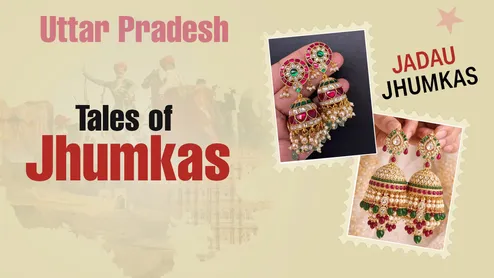
Some jewellery gets passed down with a story attached. Jadau jhumkas from Uttar Pradesh are one of those pieces. Heavy, glowing and a little bit regal, they are the kind of earrings a grandmother pulls out of a velvet box and says, "This was part of my wedding set."
From Royal Courts to Bridal Trousseaus: The History of Jadau in Uttar Pradesh
Jadau work is said to have travelled to India with the Mughals, who brought Persian ideas of setting stones in gold. Jewellers in royal courts took to it quickly. In the Awadh region and cities like Lucknow and Varanasi, courtly taste shaped how jewellery looked. It was rich, detailed and made to be noticed.
Over time, jadau moved out of palaces and into family homes. Wealthy families began ordering it for weddings, and it slowly became part of the bridal trousseau. Even today, many UP families treat a jadau set as an heirloom, not just a purchase.
What Makes Uttar Pradesh's Jadau Jhumkas Unique?
A jadau jhumka looks full. The stones sit close together, and there is hardly any gap between the gold and the colour. Most pieces carry uncut stones or polki, with a gold look that feels warm and soft instead of shiny and sharp.
The other detail is the back. Flip a good jadau jhumka and you will often find fine enamel work. This is meenakari, and it is done for the person wearing the piece, not just for the people looking at it.
How Artisans Handcraft A Jadau Jhumka
It starts with a drawing. The artisan sketches the design, and a goldsmith shapes the gold base to match it. Then comes the slow part.
Lac, a natural resin, is used to hold the stones in place. The artisan presses each stone into its spot. Thin gold foil is then wrapped around the stone to lock it in. Once the setting is done, the piece is polished, and the back is often finished with meenakari.
One jhumka can pass through many hands, and a single pair can take days or even weeks to finish. That is why no two pairs look exactly alike.
Jadau vs. Kundan vs. Polki: Clearing Up The Bridal Jewellery Confusion
Feature |
Jadau
Kundan
Polki
What It Is
A Jewellery-Making Technique Where Stones Are Set Into Gold
A Setting Style That Uses Pure Gold Foil Around Stones
Uncut, Natural Diamonds
Main Focus
The Craft And The Setting
The Gold Foil Work
The Stone Itself
Back Of The Piece
Often Has Meenakari
Usually Plain Or Simple
Depends On The Design
Look
Rich, Layered, Heirloom Feel
Bright, Traditional, Festive
Raw, Glassy, Soft Sparkle
Can They Overlap?
Yes, Jadau Pieces Often Use Kundan Setting
Yes
Yes, Polki Is Often Set In Jadau Work
So a jhumka can be jadau, kundan and polki all at once. Jadau is how it is made, kundan is how the stones are held, and polki is what the stones are.
Signature Jadau Jhumka Styles To Know
Here are a few shapes you will see most often.
- The classic dome jhumka is the one everybody pictures. It has a rounded bell shape with a row of stones and small pearl drops along the edge.
- The chandbali jhumka mixes a crescent-shaped top with a bell hanging below. It looks heavier and works well for brides.
- The pearl-drop jhumka keeps the jadau work on top and lets a string of pearls fall below it. It feels softer and a bit lighter.
- The floral or peacock jhumka has motifs worked into the design. Leaves, lotuses and peacocks show up often.
- The sahara jhumka comes with a chain that links to the hair. It is heavy and dramatic, and it is mostly worn by brides.
How To Style Jadau Jhumkas For Wedding Season?
Since jadau is bold, the outfit around it can stay simple. Here is how to wear it for different functions.
Function |
Outfit
How to wear
Mehndi
Light Pastel Lehenga Or Sharara
Small Dome Jhumkas With Pearl Drops
Haldi
Yellow Or White Cotton Suit Or Saree
Lightweight Floral Jhumkas, Nothing Too Heavy
Sangeet
Embroidered Lehenga Or Indo-Western Gown
Chandbali Jhumkas, With Hair Swept Back
Wedding
Red Or Pastel Bridal Lehenga Or Banarasi Saree
Sahara Jhumkas Or Large Jadau Pairs With A Maang Tikka
Reception
Silk Saree Or Heavy Gown
Polki-Style Jadau Jhumkas, With A Simple Neckpiece
Guest At A Wedding
Silk Saree Or Anarkali
Medium Dome Jhumkas, Wear A Small Necklace Or None
In the end, jadau jhumkas are more than just wedding jewellery. They are history, handcraft and heirloom rolled into one. Choose a pair that feels like you, and it will stay in your family long after the wedding season ends.
(Image Credits: Instagram)
Stay tuned to read more such stories on Her Zindagi.