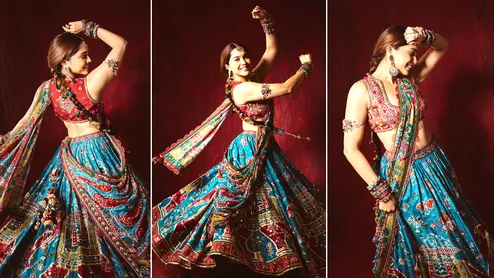
Sharvari's maximalist Torani lehenga took over 400 hours to complete. According to the designer, several artisans worked together on the printing, embroidery, stitching and even the tassels. The lehenga was made for Navratri, and with patola-inspired motifs, mirrors and cowrie shells, it is one of the loudest, most playful festive looks of the season.
Sharvari's Patola Torani Lehenga: What Is The Look All About?
This is maximalism with a story behind it. The skirt is voluminous and packed with motifs, and the choli and odhni carry the same busy, handcrafted energy. Nothing is kept plain, which is exactly what makes it work for Navratri, where bigger and bolder usually wins.
Which Torani Collection Is Sharvari's Lehenga From?
The lehenga comes from Torani's Jogiya collection. The collection draws from India's wandering storytellers, folk musicians and nomadic communities. For the designer, it was also a personal look back at his Sindhi roots and the long exchange of artisans, embroidery and colour between Sindh and Kutch. That shared heritage shaped the more-is-more feel of the outfit.
What Patola-Inspired Motifs Are Used On Sharvari's Lehenga?
The skirt brings together patola-inspired motifs like the chaupad (cross), trees of life, flowers, butterflies and geometric patterns. Smaller kitsch-inspired designs sit among them, including oversized elephants. The designer describes the panels as a moving baraat of elephants, layered with movement, memory and celebration. A vermillion red waistband and border with pixelated heart-shaped designs add a sweet, unexpected touch.
Sharvari Wagh's Torani Choli And Odhni: Mirrors, Cowrie Shells And Lattu Latkans
The sleeveless matka neck choli continues the craft story with mirrors, cowrie shells, beads and detailed hand embroidery. The skirt also features mirrors, beads, threadwork and generous tassels. A flowing georgette odhni finished with a scalloped hem and lattu latkans adds movement, which matters when the outfit is meant for Garba nights.
Why Did The Patola Lehenga Take 400 Hours To Make?
Because almost every part of it is worked by hand. Printing, embroidery, stitching and tassel-making each need their own time and skill, and several artisans worked on the lehenga together. Mirrors and shells have to be placed one by one, and the tassels are made separately before they are added. Put together, that is how a single outfit ends up with over 400 hours of work in making Torani's one piece Patola-inspired lehenga for Sharvari.
How To Style A Maximalist Lehenga For A Festival?
When the lehenga has this much going on, let it lead.
- Keep the hairstyle neat and choose jewellery that adds shine without competing with the embroidery.
- Comfortable footwear matters too, since a heavy skirt and a long night of festivities do not go well with tight shoes.
- And if you are borrowing the idea, look for prints and mirror work in a lighter fabric so you can still move freely.
Sharvari's Torani lehenga is proof that festive dressing does not have to be subtle. Sometimes the best outfit is the one with a story in every panel.
(Image: Instagram)
Stay connected to read more such interesting stories on Her Zindagi.