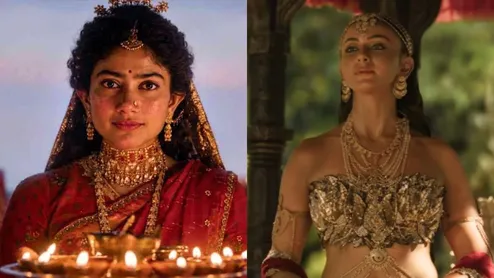
The jewellery in Nitesh Tiwari's Ramayana is not just an accessory but a storytelling. From showcasing the royal grandeur of Ayodhya to the moment Sita drops her ornaments from the Pushpak Viman, every piece has been designed to tell you the story, the characters and where they came from. The man behind this mammoth task is Tarang Arora, Creative Head of House of Amrapali. Over 4500 pieces were created for 18 months with the help of 25 designers, 45 master craftsmen, and hundreds of artisans.
Jewellery In Ramayana:
In this article, we decode how ornaments were crafted differently for different characters.
Sai Pallavi's Sita: Princess To Vanvasi
Maa Sita goes through several major changes in her life, and her jewellery reflects that. Before meeting Ram, she is a young woman, and her ornaments show youth and innocence, which later transitions into maturity.
For her wedding look, Sita wore a beautiful choodamani, which is a headpiece, along with maang tikka, matha patti, and layered necklaces. While speaking to NDTV, designer Tarang Arora said, "There is more layering. The looks are bold, but they are not bold with just one big piece. Layering adds to the magnanimity. Layering also added more femininity to Sita's look, and the floral details made her look distinct."
The team added, "Sita was a young woman when she married Rama, so this timeline must be remembered. We cannot have an 18-year-old wearing jewellery that a woman in her 30s would wear."
When Sita goes into Vanvas with Lord Ram and Lakshman, she dons a minimal look, which was created to keep in mind that she is a married woman but away from the luxury of palaces and royal grandeur.
Rakul Preet's Surpanakha:
Surpanakha, Ravana's sister, belongs to Lanka, and her jewellery is shown as bold and maximalist yet feminine. Her jewellery is sharper, wilder, and later more sensual, featuring sharper forms, darker stones, heavier cuffs, and bold armlets. This is a stark contrast to Sita's floral motifs on jewellery.
Kajal Aggarwal's Mandodari: Queen Of Lanka
Ravana's wife and queen of Lanka, Mandodari, played by Kajal Aggarwal, showcase bolder take to her ornaments as she belongs to Lanka's wealth. Her jewellery features more symmetrical compositions and warmer, luminous stones, unlike Surpanakha's, to showcase more wisdom and balance.
Lara Dutta's Kaikeyi: Powerful Queen Of Ayodhya
The jewellery of Kaikeyi, played by Lara Dutta, showcases Ayodhya with symmetrical Surya motifs, Dharma Chakra-inspired medallions, and lotus detailing. Her jewellery is formal, geometric, and commanding, unlike Sita, who is still a young woman.
ALSO READ- Ramayana Part 2 Confirmed For Diwali 2028, Makers Hint At A Trilogy
Shobhana's Kaikasi: Ravana's Mother
Angular forms and dark-hued stones contribute to an aesthetic that conveys intensity, authority, and formidable presence were used for Kaikasi along with Ravana. Her jewellery gets dark-hued stones like deep blues, blacks, and dark greens to show power. She is the palace matriarch, who wears heavy gold jewellery and a golden crown.
In Ramayana, jewellery does what dialogues cannot. Tribe Amrapali did not just create 4,500 pieces of jewellery. It created three different worlds. Which character's jewellery was your favourite? Sita's delicate choodamani or Mandodari's royal crown.
(Image Credits: Instagram)
To read more such stories, stay tuned to Her Zindagi.
To read more such stories, stay tuned to Her Zindagi.