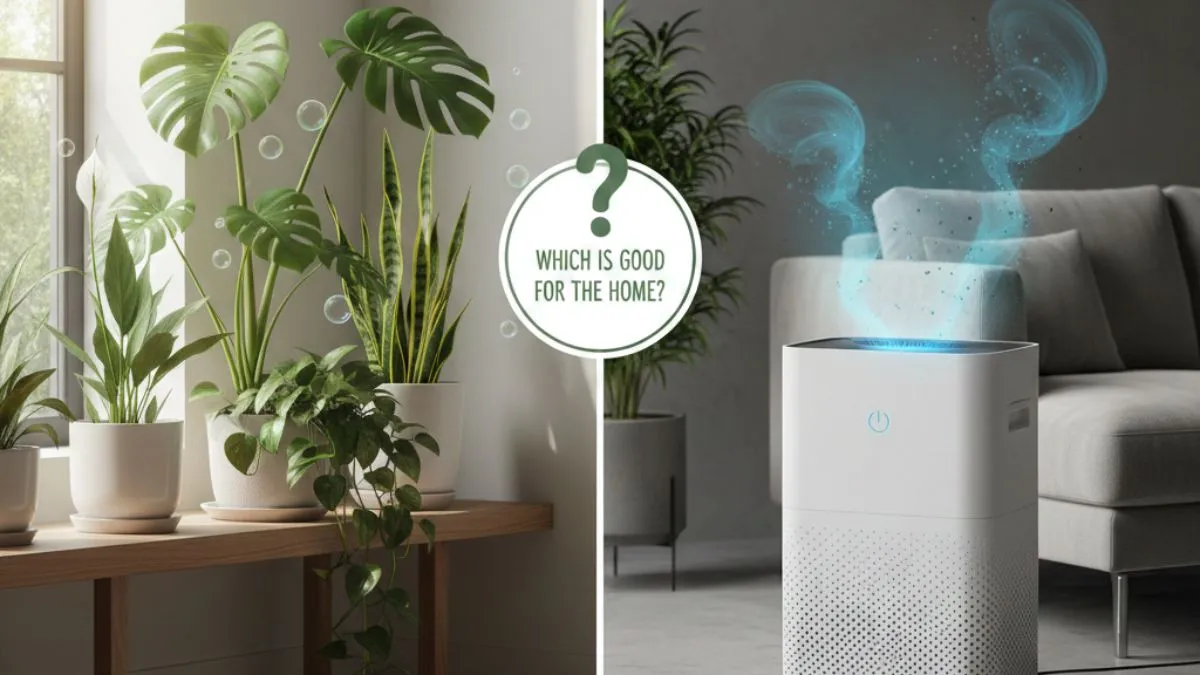
The quest for pristine indoor air has sparked a long-standing debate: nature versus technology. On one side, we have the lush, leafy appeal of indoor plants, popularised by the legendary 1989 NASA Clean Air Study. On the other hand, we have high-tech air purifiers equipped with HEPA and activated carbon filters designed to scrub the air in minutes. As you spend nearly 90% of your time indoors, the stakes for your respiratory health have never been higher.
But if you are looking to tackle modern pollutants like wildfire smoke, pet dander, or urban smog, which should you choose? In this article, we dive deep into the science of phytoremediation versus mechanical filtration to help you decide which is the best choice for your specific living space.
The Science of Indoor Plants: Can They Really Purify Air?
The idea that a few potted plants can act as living lungs for your home is an attractive one. Scientifically, plants do remove certain toxins through a process called phytoremediation
How do Plants Clean the Air?
Plants absorb gases through tiny pores in their leaves (stomata). However, research from Drexel University has clarified that the real "workhorses" aren't just the leaves, but the microorganisms living in the soil and root zones. These microbes break down Volatile Organic Compounds (VOCs) like benzene and formaldehyde.
The Best Indoor Plants for Air (Based on NASA)
If you choose the green route, these air purifier plants are consistently ranked as the most effective: Snake Plant (Sansevieria), Peace Lily (Spathiphyllum), Spider Plant (Chlorophytum comosum), and Aloe Vera.
But the reality check is, a recent meta-analyses suggest that to match the air-exchange rate of a standard home ventilation system, you would need between 10 and 1,000 plants per square meter. While plants are great for mental health and humidity, they lack the "Clean Air Delivery Rate" (CADR) required to handle heavy pollution.
The Power of Air Purifiers: Maximum Efficiency
If your goal is clinical-level air purity, a mechanical air purifier for home is the undisputed winner. Unlike passive plants, air purifiers actively pull air through a multi-stage filtration system.
Why Air Purifiers Outperform Plants?
- HEPA Filtration: True HEPA filters capture 99.97% of particles as small as 0.3 microns, including pollen, dust mites, and PM2.5. Plants cannot "eat" dust.
- Activated Carbon: This stage neutralises odours and heavy smoke that plants would take weeks to process.
- Speed: A quality purifier can cycle the air in a 500 sq. ft. room five times per hour. A plant takes days to achieve a similar VOC reduction in a sealed chamber.
Now, here are the 5 best options from both that you can consider buying for your home from Amazon. These all options have great features and have a positive buyer’s response.