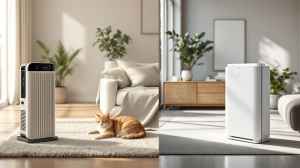
Investing in an air purifier is no longer a luxury, but a necessity for maintaining a healthy indoor environment, especially in areas struggling with high pollution levels. When you begin your search for a good air purifier for home, the sheer number of options and technical jargon, from CADR ratings to HEPA classifications, can feel overwhelming. This comprehensive air purifier buying guide is designed to simplify that journey, ensuring you know exactly how to choose an air purifier that meets your specific needs. For a better understanding we have discussed 5 best air purifiers for home use, so that you can have a clear view of what you actually need. The right purifier should efficiently remove harmful airborne pollutants, including dust, pollen, pet dander, and microscopic PM2.5 particles, without being disruptive. We'll walk you through the essential factors and provide a detailed comparison of five top-rated models to help you select the perfect device for cleaner, safer air in your living space.
Factors to consider while looking for an air purifier for home?
Choosing the best air purifier for home requires aligning the purifier's specifications with your room size and specific air quality concerns. Here are the key factors in your air purifier buying guide:
- Clean Air Delivery Rate (CADR): This is the most crucial metric. It measures the volume of clean air a purifier produces per hour (m³/h).
- Rule of Thumb: The CADR should be at least two-thirds the area of your room (in square feet) converted to cubic meters per hour for effective cleaning. A higher CADR means faster purification.
- Room Size & Coverage Area: Always buy a purifier rated for a room size larger than your actual room to ensure optimum performance and faster air changes per hour (ACH).
- Filter Type:
- True HEPA Filters (H13 is best): Essential for capturing 99.97% of particles as small as 0.3 microns (pollen, dust, pet dander, mold spores, and PM2.5). Look for "True HEPA," not "HEPA-type" or "HEPA-like."
- Activated Carbon Filter: Vital for adsorbing odors, smoke, and harmful volatile organic compounds (VOCs) and gases.
- Pre-filter: Captures larger dust and hair, protecting the life of the HEPA filter.
- Air Changes Per Hour (ACH): Indicates how many times the air in the room is fully purified in one hour. For standard use, 4-5 ACH is good; for allergy or asthma sufferers, 5+ ACH is recommended.
- Noise Level (dB): Crucial for bedrooms. Look for models with a 'Sleep Mode' that operates below 35 dB. Below 30 dB is considered whisper-quiet.
- Running Costs: Consider the power consumption (W) and, more importantly, the cost and frequency of replacement filters. A higher quality filter might cost more upfront but last longer.
- Smart Features: Real-time AQI display, Auto Mode (adjusts speed based on pollution), Timer, and Wi-Fi/App control enhance convenience.