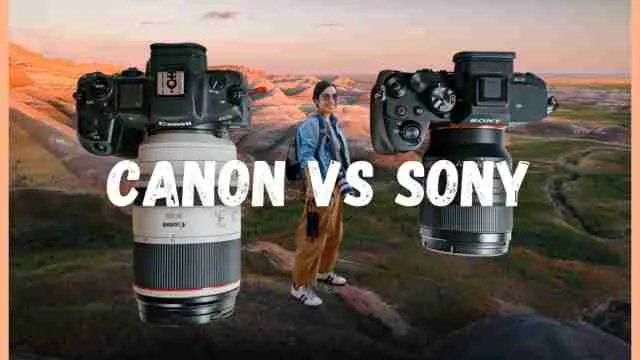
Comparing camera specs alone isn’t enough in order to make a decision about whether one should choose Sony or Canon, as these brands work differently in the field of photography and videography. Among the advantages of Sony are great autofocus, innovative sensors and good video capabilities, which makes its mirrorless cameras winning among those who shoot videos and photos at the same time. The strength of Canon includes a natural look of colours, high accuracy in tracking subjects and an enormous range of cameras available for people of different levels. In terms of mirrorless offerings, both companies have created good options but differentiation shows itself when we look closely at things like image processing, low-light photography, video recording, lenses and handling.
Check out other articles like this in our Gadget Zone section.
Sony vs Canon Mirrorless Cameras: Key Differences in Features and Specifications
|
Comparison Point |
Sony Mirrorless Cameras |
Canon Mirrorless Cameras |
|
Camera Range |
The Alpha series includes entry-level models like ZV-E10 II, enthusiast-focused A6700 and full-frame cameras like A7 IV and A7R V. |
The EOS R series offers models across different budgets, including EOS R50, R7, R6 Mark II and R5 Mark II. |
|
Sensor Options |
Offers APS-C and full-frame sensors, along with several high-resolution full-frame options. |
Offers APS-C and full-frame sensors, including high-resolution options in its professional EOS R lineup. |
|
Autofocus Technology |
Uses Real-time Recognition and Real-time Tracking autofocus features in select models. |
Uses Dual Pixel CMOS AF II with subject detection and tracking in select models. |
|
Continuous Shooting |
Offers high-speed burst shooting, with performance varying by camera model, shutter type and shooting conditions. |
Offers high-speed burst shooting, with speeds depending on the camera model, shutter type and shooting conditions. |
|
Image Stabilisation |
Selected models feature in-body image stabilisation (IBIS), while compatible lenses can provide additional optical stabilisation. |
Selected models feature in-body image stabilisation (IBIS), with compatible lenses offering additional optical stabilisation. |
|
Connectivity |
Supports Wi-Fi, Bluetooth and USB connectivity, with smartphone transfer options depending on the camera model. |
Supports Wi-Fi, Bluetooth and USB connectivity, with smartphone transfer options depending on the camera model. |