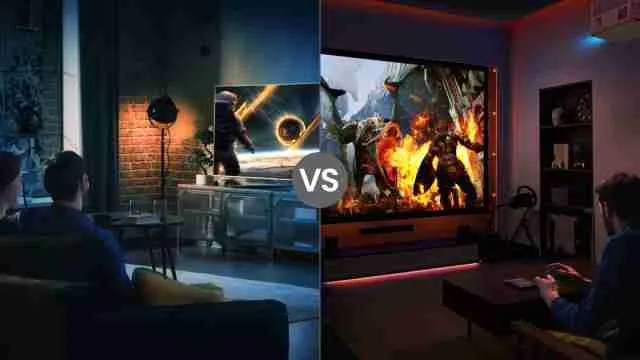
I would not look at this topic like a normal projector versus TV fight. In real homes, the winner changes with the room. A projector feels special when you sit down for a film, switch off the lights and let the wall disappear into one big frame. But it also asks for effort: darker curtains, a proper screen, clean wall space and some control over where the speakers sit. A large screen TV is not as theatrical, but it behaves better on messy days. Morning news, cricket, gaming, YouTube, family viewing, all of it feels easier because you do not have to prepare the room first. So, Projector vs. Large Screen TV is not really about who has the bigger picture. It is about which setup fits your daily life after the movie-night excitement is over.
Projector vs. Large Screen TV: Which One Is Better For Gaming And Sports?
For gaming, I would not judge this only by screen size. A projector looks exciting when you are playing story games, racing games or football titles with friends because the picture feels huge and more involving. But for fast online gaming, a large screen TV still feels safer. You get lower input lag, better refresh-rate support, VRR, sharper HDR and fewer setup issues. Many new gaming projectors have improved a lot, but you still have to check the lag number in game mode, not just the “4K” badge.
For sports, the TV has one big advantage: it handles real living rooms better. Cricket, football and F1 are usually watched with lights on, people moving around and friends sitting at different angles. A bright large TV keeps the ball, scoreboard and fast motion easier to follow.
A projector is better for a planned match night, where the room is darker and the screen is big enough to make the stadium feel larger. So for daily sports and competitive gaming, TV wins. For weekend match nights and big-screen fun, projector has its own charm.
E Gate Duster 8X Projector 4k Ultra HD | Official Netflix, Prime, Sony | 100% DustFree & Certified Android Whale OS | 8X Brighter, 1080p Native, Fully Automatic, HDMI-ARC, Chat GPT Voice Remote, EGATE
Rs. 18999
Buy NowBenQ TK700 4K UHD HDR Home Cinema Projector 3200 ANSI lumens, Excellent Colors 96% REC 709, Upto 200inches Screen Size, Sports & Game Mode, eARC, 16ms Low Input Lag, 2D Keystone,3D,HDMI, Speaker 5W
Rs. 137500
Buy NowWZATCO Yuva Vibe, Certified OS Smart Home Projector, Native 1080P Fully Automatic, HDMI ARC, WiFi 6 & BT, 14000 Lumens, Screen Mirroring, Portable Room Cinema, Black
Rs. 15490
Buy NowHisense 139 cm (55 inches) E6S Series 4K Ultra HD Smart LED Google TV 55E6S
Rs. 37990
Buy NowHisense 139 cm (55 inches) E6S Series 4K Ultra HD Smart LED Google TV 55E6S
Rs. 37990
Buy NowSony 139 cm (55 inches) BRAVIA 2M2 Series 4K Ultra HD Smart LED Google TV K-55S25BM2
Rs. 63990
Buy NowXiaomi 138 cm (55 inch) FX Pro QLED Ultra HD 4K Smart Fire TV L55MB-FPIN
Rs. 35999
Buy NowProjector vs. Large Screen TV: Which One Costs More After Setup, Screen And Long-Term Use?
The cheap projector side is real, and it should not be ignored. You can get basic projectors around 5,000 to 8,000, while better budget Full HD smart projectors usually sit around 10,000 to 20,000. Some models even talk about 150 inch or 200 inch screen size, Wi-Fi, Bluetooth, Android and 4K support in this range. But here is the catch: at this price, “4K support” mostly means it can play 4K content, not show true 4K picture. Brightness also drops once the room has tube light, window light or a cream-coloured wall.
So yes, for a hostel room, bedroom movie night or casual weekend use, a 12,000 projector plus 2,000 to 5,000 screen can feel like a bargain. Even after adding a speaker or streaming stick, the setup may stay near 20,000 to 30,000.
But the moment you want proper home-theater quality, the cost changes. A better projector, screen, mount, soundbar and curtains can easily push the setup to 60,000 to 1.5 lakh. If you go for laser projector and ALR screen, it can cross 2 lakh without trying too hard.
A TV is more expensive in size, but cleaner in cost. A 75-inch TV can start around 55,000 to 70,000, while better QLED options can go above 1 lakh. An 85-inch TV usually moves around 1.2 lakh to 4 lakh, depending on brand and display tech.
So the simple answer is: cheap projector wins for big-screen fun on a small budget. Large TV wins when you want brightness, sharpness and daily reliability without fixing the room first.
What Should You Know Before Buying A Budget Projector For Home Theatre?
Budget projectors are not useless, but they are also not magic boxes that turn every wall into a cinema screen. They work best when you know their limits before paying. The biggest mistake is buying one only because the listing says “200-inch screen” or “4K support”. In many cheap projectors, 4K support only means the device can play a 4K video. The picture you actually see may still be HD or Full HD.
For a small bedroom, 80 to 100 inches is a more sensible size. Push the same projector to 150 inches and the picture may start looking soft, dull and washed out. A plain wall also affects the result. If the wall has texture, cream paint or marks, you will see it while watching bright scenes.
Brightness is another area where people get fooled. A projector that looks fine at night may look weak with tube light, window light or even a bright white ceiling. So before buying, think about your room first. Curtains, wall colour and viewing time matter as much as the projector.
Also check boring things like fan noise, speaker quality, HDMI port, app support and service. Some budget smart projectors have Android, but Netflix or Prime may not work smoothly, so you may still need a Fire TV Stick. Bluetooth speakers can also create sound delay sometimes.
A budget projector makes sense for night movies, kids, hostel rooms, casual cricket nights and weekend fun. But if you want sharp daylight viewing, proper HDR, serious gaming and daily family use, a large TV is still the safer choice.
WZATCO Yuva Go Plus, 1080P Native Projector, Android 13.0 Smart Home, Rotatable, Auto & 4D Keystone, 9000 Lumens, WiFi-6 & BT, Screen Mirroring, ARC, Room Portable Cinema, White
Rs. 7690
Buy NowE GATE Atom 3X Projector 4k Ultra HD Full HD 1080p Native Automatic Home Projector for Room | 300 ISO | Rotatable Design | Android Netflix Prime | ARC-HDMI USB WiFi-6 BT Screen Mirroring Egate
Rs. 7579
Buy NowLifelong Electronics Lightbeam Smart Projector | Android, 1080P& 4K Ultra Support, 3000 Lumens, 720p Native | for Room & Outdoors | All OTT Apps | WiFi/BT, Mirroring, USB, HDMI, 180°, Speakers
Rs. 5999
Buy NowZebronics Android Smart LED Projector, 4K UHD Support, 4000 Lumens, 100" Screen Size, 240° Tiltable, Auto Keystone, OTT Apps (Netflix, Prime), Miracast, WiFi, BT v5.4, HDMI, USB (Pixaplay 35)
Rs. 5999
Buy NowLumio Arc 5 Portable Home Projector | Official Google TV with Netflix | Native 1080p Full HD | 4K Support | 200 ANSI Lumens | Auto Keystone | Dolby Audio | Sealed Light Engine | Bluetooth Speaker
Rs. 19990
Buy NowPortronics Beem 440 Smart LED Projector with 720p HD Resolution, Rotatable Design, Built-in Streaming Apps (Netflix, Prime Video, Hotstar), 2200 Lumens, Screen Mirroring, 3 Watts Speaker (White)
Rs. 6799
Buy NowE Gate Zen 7X Official Google TV Projector | Fully Automatic & 100% Dust-Free | 700 ISO | Dolby Audio | Projector 4K Ultra HD, modulated at 1080p Native | Voice Remote, ChromeCast, 1GB-32GB, Egate
Rs. 19990
Buy NowWhat Makes A Large Screen TV More Practical Than A Projector?
I find a large screen TV more practical when the home theater is also used like a normal family room. You switch it on and it works. No curtain closing, no wall checking, no focus setting, no screen alignment. That matters when people are watching cricket, news, YouTube, OTT shows, cartoons, gaming and movies in the same room.
The biggest plus is brightness. A TV can handle daylight, tube light and side lamps much better than a projector. With a projector, even a little room light can make blacks look grey and colours look dull. A TV keeps the picture punchier, especially for HDR scenes, sports scoreboards and dark movie scenes. RTINGS also treats brightness and reflection handling as key parts of bright-room TV performance.
Gaming is another strong reason. Many large TVs for gaming now come with 120Hz or higher refresh rate, HDMI 2.1, VRR and low input lag. Projectors have improved, but budget and mid-range models still need careful checking before gaming. Some projectors are better for slow, cinematic games, not fast online matches.
Sound is also easier with a TV. You can place a soundbar under it and the sound feels connected to the screen. With projectors, the machine may sit behind you, above you or far from the wall, so audio placement needs more planning.
I would say a projector is better for a dark, planned movie night. But for daily home theater use, a large TV is simpler, sharper, brighter and less demanding. It does not ask your room to behave perfectly every time.
TCL 189 cm (75 inches) 4K Ultra HD Smart QLED Google TV 75P71K
Rs. 72990
Buy NowToshiba 248 cm (98 Inches) 4K Ultra HD Smart QLED TV | Dolby Vision Atmos, HDR10+ | 144 Hz Panel | 2.1 CH 61W Speaker with Sub Woofer | REGZA Engine ZRi | Voice Control | VIDAA OS | 98Z570RP (Black)
Rs. 249999
Buy NowPhilips 190 cm (75 inch) 8100 Series 4K Ultra HD Smart QLED Google TV 75PQT8100/94
Rs. 67999
Buy NowSony BRAVIA 3 Series 189 cm (75 inches) 4K Ultra HD AI Smart LED Google TV K-75S30 (Black)
Rs. 143990
Buy NowHisense 215 cm (85 Inches) 4K Ultra HD Smart QLED TV | Dolby Vision Atmos, HDR10+ | 30W Powerful Speaker | AI 4K Upscaler | ALLM | MEMC | HDR 10+Decoding | Voice Control | VIDAA OS | 85E7Q (Black)
Rs. 119999
Buy NowVu 189cm (75 inches) Masterpiece Frame Series 4K QLED TV 75MASTERPIECE (Armani Gold)
Rs. 86990
Buy NowHisense 305 cm (120 inches) Trichrom ALR Screen Series 4K Ultra HD Smart Laser TV 120L9HE (Black)
Rs. 399999
Buy NowWho Should Buy A Projector And Who Should Buy A Large Screen TV?
I would decide this by how the screen will be used after 30 days, not by how exciting it looks on day one.
A projector is for someone who watches with intention. You start a movie, sit properly, keep snacks ready, and watch for two hours. It is good when the room has one clear wall, fixed seating, and no one needs that wall for shelves, paintings, study table or daily movement. It also suits people who do not mind a slightly slower setup. Power on, focus, source, sound, screen size, all these small things are part of the projector life.
I would also pick a projector for a room where the screen can stay hidden. For example, a roll-down screen in a bedroom, a media room, or a rented flat where you do not want to bring a massive TV. It gives big size without making the room look permanently occupied by a black rectangle.
A large screen TV is for a house where the screen is used in pieces. Ten minutes of news, half an hour of YouTube, one cricket over, kids watching cartoons, someone playing console, then OTT at night. TV handles this casual usage better because anyone can use it without thinking.
TV is also better when the room is shared by family. No one has to ask, Can we close the curtains? or “Who moved the projector?” It stays ready, which is a bigger benefit than people realise.
So my simple split is this: buy a projector if the room is built around watching. Buy a large TV if watching has to fit into the room.
Conclusion
In the end, I would not call one setup better for everyone. A projector is good when the room supports it and you really want that movie-night feeling. A large screen TV makes more sense when the same screen is used daily by the whole family. It handles light, sports, gaming and casual watching with less effort. So before picking between Projector vs. Large Screen TV, look at your room first, not just the screen size. If watching is an event, go for a projector. If watching is part of daily life, a large TV is the easier choice.
Disclaimer: At Her Zindagi Your Picks, we prioritize providing up-to-date information on the latest trending commodities and goods. Links in this article are affiliate links. Please note that our product recommendations are based on independent research and analysis however, Her Zindagi Your Picks shall not be held liable for any claims, damages, or disputes arising under applicable laws, including the Consumer Protection Act, 2019. Any issues regarding product quality, delivery, or warranties must be directed to the respective manufacturer or seller. Furthermore, the products featured in this article are organized for reader convenience and are listed in no particular order of priority or ranking.
Faq's
Is a projector better than a large screen TV for home theatre?
For movie nights, yes, but only in a dark room. In a normal living room, TV feels easier.
Can a budget projector replace a TV?
I would not use it as the main screen. It is good for weekend movies, not daily family watching.
Which one is better for sports and gaming?
TV, mostly. Cricket, football and gaming need brightness, fast response and less room adjustment.
Is a projector cheaper than a large screen TV?
The machine can be cheaper, but screen, speaker, curtains and setup slowly add to the bill.